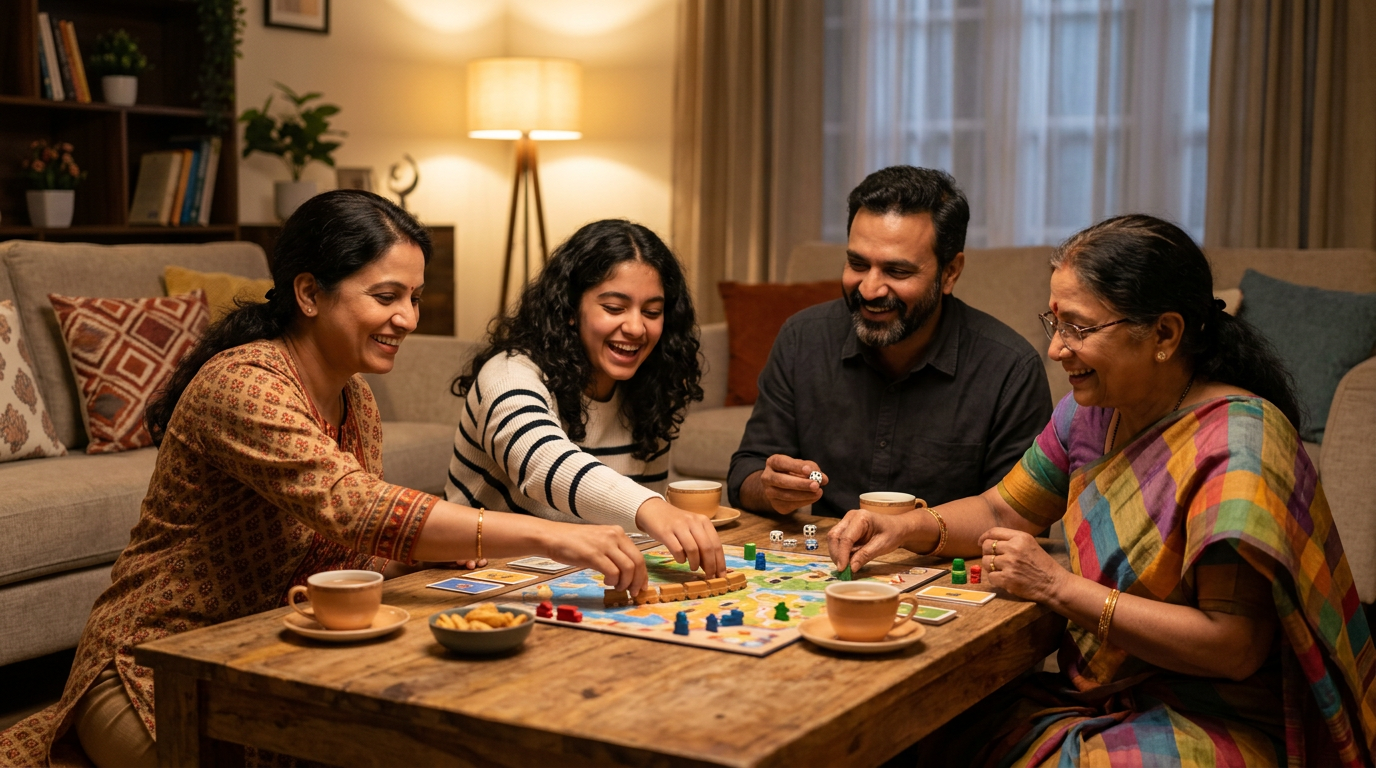
India invented Chaturanga and Pachisi. In 2026, it is rediscovering board games all over again—from Codenames tables in cafes to Catan arguments at home.
Walk into a Saturday-evening cafe in Indiranagar, Powai, or Bhubaneswar right now, and you'll see a scene that barely existed in urban India a decade ago: mixed groups of cousins, parents, and friends arguing over one-word clues, train routes, and bird habitats instead of scrolling separate screens. The board game wave is no longer niche. It is social infrastructure.

This guide is built for one practical outcome: help you buy the right game for your family this week, not bury you in 50 titles you'll never play. You'll get India-specific trends, a 3-question decision filter, a curated shortlist by family type, real community/forum signals, Instagram links, and direct places to buy in India.
The Great Indian Game Night Revival (Why this is happening now)
- Screen fatigue is real: families want one activity that keeps three generations in one room.
- Cafe discovery flywheel: try at a board game cafe, then buy for home.
- Indian market momentum: industry estimates place India around USD 1.70B (2024) with projections near USD 3.80B by 2033 (around 8.60% CAGR).
- Made-in-India design is maturing: titles like Shasn, Mantri Cards, and newer desi party games are now part of the same shelf as Catan and Ticket to Ride.
- Co-op games are mainstream: families increasingly choose "beat the game together" over "destroy each other."
India context: Pachisi evolved into modern Ludo, and Chaturanga evolved into chess. The current boom is not just nostalgia. It is a deliberate trade: less screen, more eye contact.
Before You Buy: 3 Questions That Prevent Bad Purchases
Q1. Who is actually at the table?
If a 7-year-old and a grandparent are both in, choose a cooperative or very light gateway title.
Q2. How long will your family really sit?
If your table taps out at 45 minutes, don't buy 90-minute games first.
Q3. Does your family enjoy confrontation?
If yes, Catan shines. If no, start with Pandemic / Forbidden Island / Just One.
Community Pulse: What Forum Players Repeatedly Say
Instead of random one-off quotes, these are recurring patterns from major forum threads that align with what Indian families report in cafes and meetups:
- Ticket to Ride works younger than expected: multiple BoardGameGeek/parent threads report kids around 6-8 can play with light assistance, especially Europe due to stations reducing "got blocked, game over" frustration.
- Codenames scales bigger than the box says: players routinely run 10-12 by using team discipline, timers, and occasionally co-spymasters.
- Pandemic wins families over because it reduces table drama: common strategy threads stress role synergy and communication, which mixed-skill households like.
Forum links: BGG: Ticket to Ride with children · BGG: Codenames over 8 players · BGG: Pandemic beginner strategy
The Curated Shortlist (By Family Type)
A) Quick & Loud (festivals, cousins, mixed ages)
- Taco Cat Goat Cheese Pizza — 2-8 players, 15 min, ages 8+.
- Codenames — 2-8+ players, 15-30 min, ages 10+.
- Just One — 3-7 players, 20 min, ages 8+.
- Dobble / Spot It! — 2-8 players, 15 min, ages 6+.
B) Gateway Games (first "real" modern board game)
- Ticket to Ride: Europe — 2-5 players, 30-60 min, ages 8+.
- Catan — 3-4 players, 60-90 min, ages 10+.
- Carcassonne — 2-5 players, 30-45 min, ages 7+.
- Azul — 2-4 players, 30-45 min, ages 8+.
- Kingdomino — 2-4 players, 15 min, ages 8+.
C) Cooperative (fewer fights, better for mixed skill)
- Pandemic — 2-4 players, ~45 min, ages 8+.
- Forbidden Island — 2-4 players, ~30 min, ages 10+.
- The Crew: Mission Deep Sea — 3-5 players, ~20 min, ages 10+.
D) Strategy Step-Up (teens/adults/already hooked)
- Wingspan — 1-5 players, 40-70 min, ages 10+.
- 7 Wonders — 3-7 players, ~30 min, ages 10+.
- Splendor — 2-4 players, ~30 min, ages 10+.
- Cascadia — 1-4 players, 30-45 min, ages 10+.
E) Made-in-India worth trying
- Shasn (Memesys Lab) — political strategy, 2-5 players.
- Mantri Cards (Bored Game Company) — quick family card game.
- Desi Board Games titles — easy social icebreakers for casual nights.
Instagram Pulse (Games people are actually posting about)
If you want to sense what is currently hot, these posts/profiles are useful snapshots:
- Funskool: Catan India Championship post — evidence of organized Catan momentum in India.
- The Board Room India: Codenames tournament — party-word games drawing competitive crowds.
- Dice & Fork: Codenames tournament announcement — another cafe-level proof point.
- Chai & Games (Mumbai) — short-form teaches and accessible game-night reels.
- Board Game Arena: Ticket to Ride Europe launch post — why this gateway keeps getting fresh social discovery.
Where to Buy in India (Trusted, practical links)
Primary stores: Boardgamesindia.com · Bored Game Company · Desi Board Games · Amazon India (check seller ratings carefully).
Direct product links
- Buy Ticket to Ride
- Buy Catan
- Buy Pandemic
- Buy Codenames
- Buy Mantri Cards (India-made)
- Buy Shasn (India-made)
Price note: imported boxes in India usually carry a premium versus US/EU pricing; if you find a high-demand winner near MSRP, buy while in stock.
The 3-Game Starter Bundle (Most families should begin here)
- Ticket to Ride: Europe — your reliable everyone-can-play anchor.
- Codenames — your big-group instant icebreaker.
- Pandemic (or Forbidden Island) — your zero-drama cooperative night.
Total typical spend in India: roughly ₹7,500-₹10,000 depending on stock and imports.
SEO Bonus: Quick answers families search for
Which board game should an Indian family buy first in 2026?
For most families with kids 8+, start with Ticket to Ride: Europe. It is easy to teach, replayable, and works across age gaps.
Are modern board games better than Monopoly for family night?
For many groups, yes. Newer designs usually reduce downtime, reduce player elimination, and keep all players engaged until the end.
What is the best cooperative family game in India right now?
Pandemic remains the safest recommendation for mixed-age households; Forbidden Island is a shorter, cheaper first step.
Final Word
The "best family board game" is not a single box. It is the one your people will actually replay. India's 2026 game-night revival is working because it solves a modern problem with an old answer: one table, one shared objective, one evening where nobody is half-present.
Pick one game from this list. Play it this Saturday. Upgrade later.
Related reading
- Perfect gateway board games — If your family is moving beyond UNO and Monopoly, this is the clean next step list.
- Carcassonne review (2026) — A calmer tile-laying option for families who want strategy without aggressive conflict.
- Wandering Towers review (2026) — A modern family title with fast turns and high table energy.
- Ludo in India (2026) — The cultural bridge from Pachisi-era nostalgia to modern tabletop habits.
Have a game your family swears by? Add it in the comments and we will include community picks in the next update.