Most “best board games for kids” lists assume you’ve got a whole table of players. The reality for a lot of households in 2026 is different — one parent, one kid, twenty quiet minutes after dinner before bedtime. Maybe a sibling is at a class. Maybe you’re an only child’s go-to opponent. Maybe you’ve finally accepted that game night isn’t going to involve four players ever again.
Whatever the reason, the best 2-player board games for 6 year olds are a genuinely distinct category. Most family games are designed around 3–4 players and feel slightly empty head-to-head. The games on this list are different — they’re either built specifically for two, or they actively get better at two players than three or four.
If you want general board game picks for this age, our definitive ranked guide to the best board games for 6 year olds in 2026 covers that. If you want skill-builders, see our educational board games for 6 year olds guide. This page is purely for parent + kid play.
Start with our complete guide → Best board games for kids in 2026 (toddlers through age 10) before this age-specific list.
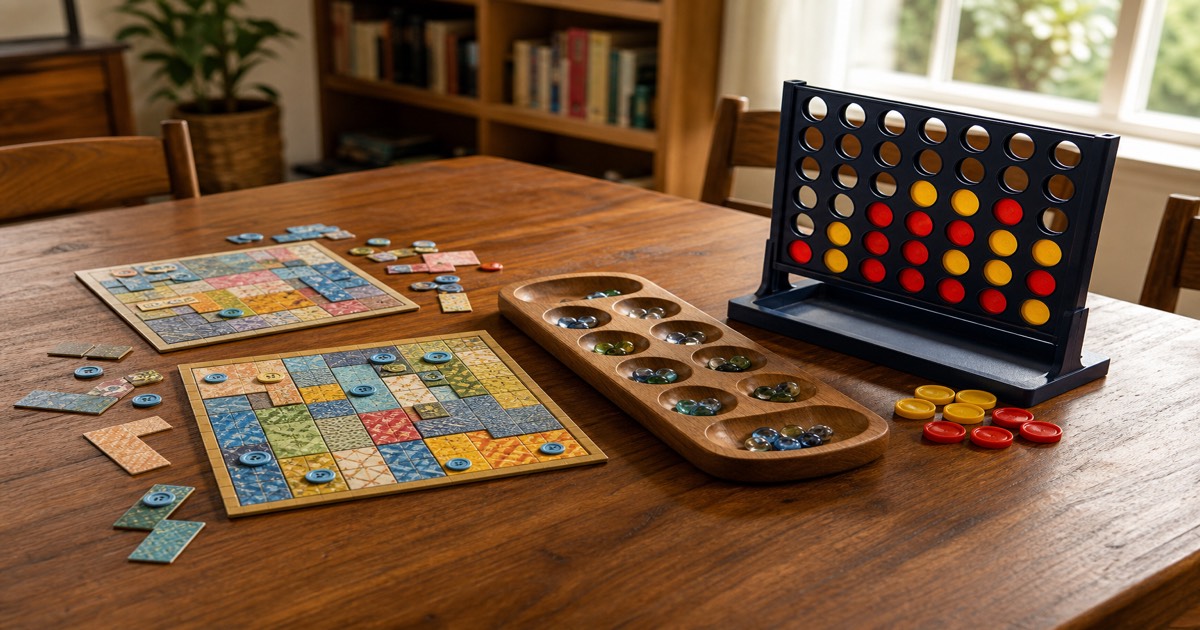
What Makes a 2-Player Game Work at Age 6
A two-player game with a six-year-old has unique demands you don’t get with bigger tables. The kid is playing against you specifically, which means:
- You can’t hide behind the group. If the game is bad, there’s no third player to absorb the boredom.
- The kid can’t lose to “the group dynamic.” Every loss is to you directly, which means loss-tolerance matters more.
- Downtime is brutal. With four players, a kid can lose focus on their turn. With two, there’s no off-turn — both of you are always engaged.
- Real strategy starts showing up. Two-player games tend to be deeper, because there’s nowhere for randomness to hide.
The games below all clear those bars. We’ve also been honest about which ones we don’t recommend, even when they show up on every other 2-player list (no, you shouldn’t try to play chess with a six-year-old before they’re ready — they will hate it and you).
Top 12 Best 2-Player Board Games for 6 Year Olds in 2026
1. Patchwork
/pic2537180.jpg)
Time: 20–30 min · Officially: 8+ (works at 6 with help) · Type: Abstract strategy
The undisputed gold standard of 2-player board games. Players take turns buying Tetris-shaped fabric pieces and stitching them onto a personal quilt board. Officially marked age 8+, but most six-year-olds handle it beautifully — the spatial puzzle is intuitive and the strategy reveals itself over a few games. Plays in about 25 minutes, ages alongside your kid for years, and you’ll actually enjoy losing to them by the time they’re nine.
Why it’s #1 for parent + kid: No randomness, no luck, no waiting. Every turn is meaningful for both of you.
Buy: Amazon.in (Lookout Spiele) · Amazon US · BGG
2. Mancala
Time: 10–15 min · Age: 6+ · Type: Ancient classic
A 4,000-year-old African counting game that happens to be one of the best games ever invented for parent + kid play. Move stones around a wooden board, capture your opponent’s pieces, win when one side is empty. Six-year-olds learn the rhythm in two games. The tactile satisfaction of moving stones is unmatched, and the rules are simple enough that nothing breaks the flow. In India, this exists as Pallanguzhi in the South — same family of game, same instinctive appeal.
Buy: Amazon.in (wooden boards from ₹500) · Amazon US
3. Hive Pocket
Time: 15 min · Age: 8+ (works at 6 with simplified pieces) · Type: Abstract strategy
Chess for kids who aren’t ready for chess. Players place hexagonal bug tiles, each with a different movement rule, trying to surround the opponent’s Queen Bee. The “pocket” version is smaller, cheaper, travel-friendly, and entirely sufficient. Start with just three piece types until your kid is comfortable, then add the rest. Plays anywhere — train, plane, restaurant table.
Buy: Amazon.in · Amazon US (Gen42 Games) · BGG
4. Connect 4
Time: 5–10 min · Age: 6+ · Type: Classic 2-player
The benchmark. Drop discs into the grid, get four in a row, you win. Connect 4 is genuinely a great game — strategically deeper than it looks, and the perfect length for “one more game” before bed. Every household with a six-year-old should own a copy, and they’re under ₹500 / $10.
Buy: Amazon.in (Funskool) · Amazon US (Hasbro)
5. Battleship
Time: 20 min · Age: 7+ (works at 6 once they can use a grid) · Type: Classic 2-player deduction
The classic. Hide your ships, call out coordinates, sink the opponent’s fleet. The catch at six is the coordinate system (B-7, F-3) — some kids handle it immediately, others need a few games. Once they get it, the deductive instincts start firing. We’ve watched six-year-olds genuinely outthink adults at Battleship after just a few plays.
Buy: Amazon.in · Amazon US (Hasbro) · BGG
6. Quoridor
Time: 15–20 min · Age: 6+ (Quoridor Kid version) · Type: Spatial strategy
Move your pawn to the opposite side of the board while placing fences to slow your opponent. Quoridor Kid (the official simplified version, ages 5+) uses a smaller board and friendly carrot-and-rabbit theming. The full Quoridor works at 7+. One of the cleanest spatial-reasoning games ever made, and gorgeous wooden production.
Buy: Amazon.in · Amazon US (Gigamic) · BGG
7. Pengoloo
/pic412246.jpg)
Time: 15 min · Age: 4+ · Type: Memory race
A 2-to-4 player memory game with wooden penguins. Roll dice, peek under penguins, find the eggs that match the colour you rolled. Plays beautifully head-to-head with a six-year-old and the wooden production is gorgeous. We’ve recommended this to dozens of parents looking for a “memory game that doesn’t feel like Memory.”
Buy: Amazon.in · Amazon US (Blue Orange Games) · BGG
8. Lost Cities
Time: 20–30 min · Age: 10+ (works at 7 with help; stretch goal at 6) · Type: Card-driven exploration
The classic 2-player card game from designer Reiner Knizia. Play cards into colour-coded expeditions, scoring more for longer runs but paying a penalty if you start an expedition and don’t commit. Officially aged at 10+, but mathy six-year-olds can manage it with some hand-holding through the scoring. Save this one for the back half of the year, when they’ve outgrown Connect 4.
Buy: Amazon.in · Amazon US (Thames & Kosmos) · BGG
9. Onitama
Time: 15 min · Age: 8+ (works at 6 with patience) · Type: Abstract strategy
A chess-style game with a twist: each player has only five pieces, and the movement rules come from a shared pool of five movement cards that rotate every turn. The “no permanent rules” structure is genuinely easier for kids than chess because they don’t need to memorise piece movements. Beautiful production. Slightly stretchy at six, perfect at seven.
Buy: Amazon.in · Amazon US (Arcane Wonders) · BGG
10. Sushi Go!
/pic1900075.jpg)
Time: 15 min · Age: 8+ (works at 6 with the visual icons) · Type: Card drafting
We’ve recommended Sushi Go! in nearly every list on this site and there’s a reason — it plays beautifully at every player count from 2 to 5. At 2 players, you draft from a smaller hand and the strategy gets sharper. The art does the heavy lifting for pre-readers.
Buy: Amazon.in · Amazon US (Gamewright) · BGG
11. Animal Upon Animal (Tier auf Tier)
/pic403502.jpg)
Time: 15 min · Age: 4+ · Type: Dexterity
HABA’s classic wooden stacking game works at any player count, but 2-player matches are surprisingly intense. The wobbling crocodile, the hedgehog balanced on its nose, the snake draped across — kids and adults compete on completely level ground. Beautiful wooden production that survives India’s humidity better than cardboard alternatives.
Buy: Amazon.in · Amazon US (HABA) · BGG
12. Spot It! / Dobble (Head-to-Head Mode)
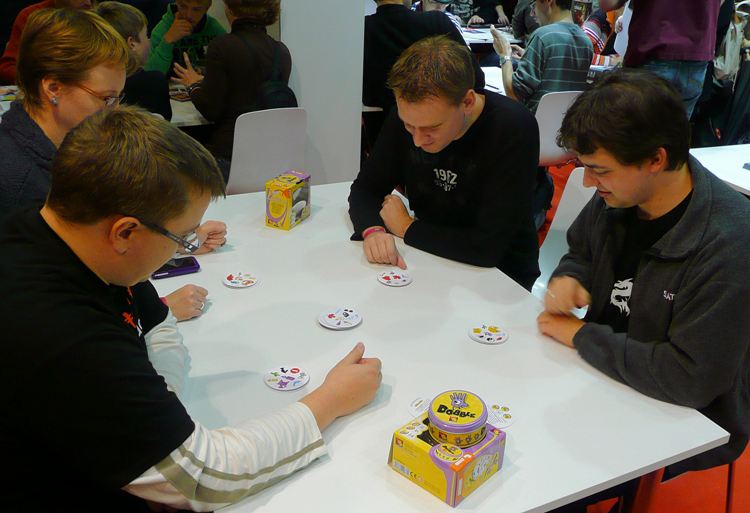
Time: 5–10 min · Age: 6+ · Type: Visual speed
The party game that’s still excellent 2-player. There are several head-to-head modes in the rulebook — “The Tower,” “The Well,” and “The Hot Potato” — all of which play perfectly with just two. Five minutes a game, throws into a backpack, costs almost nothing. The kind of game that earns its shelf space ten times over.
Buy: Amazon.in (Dobble) · Amazon US (Spot It!) · BGG
Quick Comparison: 2-Player Board Games for Six Year Olds
| Game | Time | Pure 2P? | Best For |
|---|---|---|---|
| Patchwork | 20–30 min | Yes | Strategy gold standard |
| Mancala | 10–15 min | Yes | Tactile + ancient |
| Hive Pocket | 15 min | Yes | Chess gateway |
| Connect 4 | 5–10 min | Yes | Universal classic |
| Battleship | 20 min | Yes | First deduction game |
| Quoridor (Kid) | 15–20 min | Yes | Spatial strategy |
| Pengoloo | 15 min | No (2–4P) | Wooden memory |
| Lost Cities | 20–30 min | Yes | Mathy kids, stretchy |
| Onitama | 15 min | Yes | Chess for kids |
| Sushi Go! | 15 min | No (2–5P) | Travel + drafting |
| Animal Upon Animal | 15 min | No (2–4P) | Wooden dexterity |
| Spot It! / Dobble | 5–10 min | No (2–8P) | Quick fillers |
Games We Don’t Recommend at 2 Players (Even When Other Lists Do)
A few honest counter-recommendations, because most “best 2-player kids games” listicles include these and we genuinely think they fail at six:
- Chess. Yes, prodigies exist. For most six-year-olds, chess at this age is frustration training. Wait until 7 or 8, or use Onitama as a bridge.
- Monopoly Junior 2-player. Monopoly with two players is a war of attrition that lasts forty minutes too long.
- Candyland / Snakes and Ladders. Pure luck. No decisions. Six-year-olds outgrew these at four — please don’t bring them back.
- Ticket to Ride: My First Journey at 2 players. Works fine, but plays slightly hollow head-to-head. We’d reach for it at 3–4 and pick Patchwork at 2.
- Catan Junior at 2 players. Designed for 2–4 but genuinely better at 3+. Save it for when there’s a third player.
Buying 2-Player Games in India: Quick Notes
Most picks on this list are stocked reliably on Amazon.in in 2026. A few specifics:
- Cheap and easy: Connect 4, Battleship (Funskool India versions), wooden Mancala boards, Spot It! / Dobble — all under ₹1,000.
- Moderate price, easy to find: Animal Upon Animal, Pengoloo, Quoridor Kid, Sushi Go! — ₹1,500–₹2,500 on Amazon.in and IGGames.
- Premium, occasionally tricky: Patchwork, Onitama, Lost Cities, Hive Pocket — ₹2,000–₹3,500. Stock fluctuates; IGGames and Dice and Decks are more reliable than Amazon for these.
- Pallanguzhi (South Indian Mancala): Often available on Etsy India and Amazon.in from artisan sellers — beautiful, gift-worthy, and culturally rooted.
For a broader India-focused game shelf, see our best board games for 6 year olds in India guide.
How to Make 2-Player Games Work Long-Term
- Don’t always win. A kid who loses every time stops playing. A kid who wins maybe 40% of the time stays engaged for years.
- Don’t always lose, either. Kids see through fake losses by age six and it kills the credibility of every future win.
- Talk through your turns. “I’m placing this piece here because…” teaches strategy faster than any tutorial. Don’t lecture — narrate.
- Have two games on rotation. A short one (Connect 4, Spot It!, Mancala) and a longer one (Patchwork, Quoridor). Mood-match.
- Stop while they want more. End on a high. The shelf earns more long-term play from a 15-minute session that ends with “let’s play again tomorrow” than from a 45-minute session that ends with whining.
Frequently Asked Questions
What is the best 2-player board game for a 6 year old?
For most parent + kid pairs in 2026, Patchwork is the strongest single pick. It’s designed for exactly two players, the spatial puzzle suits this age, and it grows with the kid for years. If Patchwork is unavailable or out of budget, Mancala is the universal fallback — cheaper, simpler, and equally good for daily play.
Are there good 2-player board games for 6 year olds under ₹1000?
Yes. Connect 4, Mancala, Spot It! / Dobble, and Battleship are all under ₹1,000 in India in 2026 and all genuinely excellent. You can build a complete 2-player starter collection for under ₹3,500 with those four games.
Can a 6 year old learn chess yet?
Some can, most can’t yet — and pushing it too early often creates a lasting dislike. Better intermediate steps: Hive Pocket, Onitama, and Connect 4 all build the same strategic instincts without the steep learning curve. Most kids are ready for actual chess somewhere between 7 and 9.
What’s the difference between “true 2-player” games and games that “work at 2”?
True 2-player games (Patchwork, Hive, Onitama, Battleship, Lost Cities, Connect 4) are designed exclusively for two players. Games that “work at 2” (Sushi Go!, Animal Upon Animal, Spot It!) are scalable — fine at 2 but designed with bigger tables in mind. For one-on-one parent + kid play, true 2-player games usually feel more satisfying.
How long should a 2-player session with a 6 year old last?
15–25 minutes is the sweet spot. Two short games beat one long one. If your kid is asking to keep playing after 25 minutes, that’s the signal you’ve found a good game — but stop anyway. End on a high, come back tomorrow.
Final Word
If you’re building a 2-player game shelf from zero, start with Patchwork, Mancala, Connect 4, and Spot It! — four boxes, four very different play styles, under ₹4,500 / $50 total. That’s a complete starter kit for a year of nightly parent + kid sessions.
Add Quoridor or Hive Pocket when they’re ready for deeper strategy. Add Onitama or Lost Cities when they hit seven. The shelf grows naturally from there, and so will the kid.
Related reading
- Best board games for 6 year olds in 2026: the definitive ranked buyer’s guide — Fun-first ranked list when you want variety beyond head-to-head play.
- Educational board games for 6 year olds in 2026 — Math, reading, logic and STEM picks that pair with strategy nights.
- Board games for 6-year-olds (2026): Dragomino, co-ops, first adventures — Cooperative picks when you want teamwork instead of competition.
- Best memory games for kids in 2026 — Pengoloo and Spot It! overlap with memory-first recommendations.
- Best family board games in India (2026) — India stocking reality and cultural game-night context.
Got a favourite 2-player pick we missed? Drop it in the comments or tag us on Instagram. We update this list every quarter based on what families actually keep on rotation.
Leave a Reply