Here’s the dirty secret about “educational” board games: most of them aren’t very educational, and the ones that are educational mostly aren’t fun. Walk down any toy aisle in 2026 and you’ll find shelves of brightly coloured boxes promising to teach reading, math, STEM, emotional intelligence, and probably string theory. Open the box and roughly 70% of them are a worksheet wearing a board.
The good news is the other 30% are extraordinary. The best educational board games for 6 year olds in 2026 do something worksheets cannot: they hide genuine skill-building inside a game your kid actively asks to play. A six-year-old doing addition for forty-five minutes of Sum Swamp will outperform the same kid forced through forty-five minutes of math drills, every single time. Repetition without resistance — that’s the trick.
This guide covers the educational games we actually recommend for 6-year-olds across four skill areas: math, reading and literacy, logic and problem-solving, and STEM/spatial reasoning. If you want a general ranked list of fun games for this age, see our definitive ranked guide to the best board games for 6 year olds in 2026. This page is for parents specifically looking to sneak learning past the homework filter.
Start with our complete guide → Best board games for kids in 2026 (toddlers through age 10) before this age-specific list.
What 6-Year-Olds Are Actually Learning in First Grade
Before the picks, a quick map of what your kid’s brain is wiring in 2026. Most first-grade CBSE, ICSE, and Common Core curricula converge on the same milestones:
- Math: addition and subtraction within 20, place value (tens and ones), basic shapes, counting money and time.
- Reading: phonics blending, sight words, short-sentence fluency, simple comprehension.
- Logic: sorting, pattern recognition, sequencing, first-cause-and-effect reasoning.
- Spatial / STEM: simple maps, basic measurement, fitting shapes together, predicting outcomes.
Every educational game on this list maps to at least one of these. The ones that map to two or three are the keepers.
A 2024 meta-analysis from the University of Cambridge’s Centre for Attention, Learning and Memory found that game-based learning at ages five to seven produced retention rates roughly 25–30% higher than traditional drill methods, with the strongest effects in numeracy. The boring takeaway: play is genuinely how this age learns. The fun takeaway: you have permission to skip the worksheet and break out the dice.
Best Math Board Games for 6 Year Olds (2026)
First-grade math is mostly counting, adding, subtracting, and noticing patterns. The games below all run on those exact mechanics — your kid isn’t doing math because the game requires it, they’re playing a game that happens to be math.
1. Sum Swamp
Players: 2–4 · Time: 15 min · Age: 5+ · Skill: Addition, subtraction, odd/even
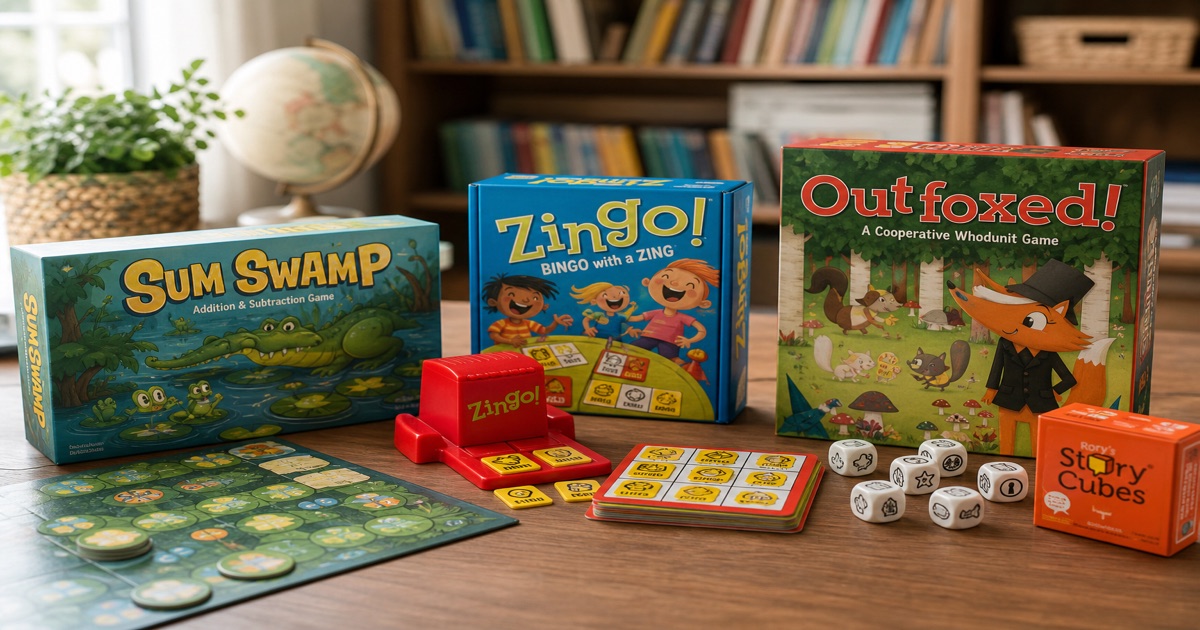
Roll two number dice and an operation die, do the math, advance your alligator across the swamp. That’s it. Sum Swamp is the most-recommended first math board game on every educator forum in 2026 and the reason is simple — it removes math anxiety by making the operation a side-effect of the game, not the point. Six-year-olds finish a game having done about 40 sums and have no idea they were practising.
Why it works: Failure has no penalty (you just move fewer spaces), so kids try harder problems.
Buy: Amazon.in · Amazon US (Learning Resources)
2. Tiny Polka Dot
Players: 1–6 · Time: 10–15 min · Age: 4+ · Skill: Counting, arithmetic, number sense
A deck of beautifully designed cards with sixteen different number games built in — from “match the pairs” to “race to one hundred.” Tiny Polka Dot is the dark horse of math education in 2026; it’s used in Montessori classrooms across the US and India and it scales from age 4 to age 8 because the difficulty changes with the game, not the cards.
Why parents love it: Sixteen games in one box means it stays fresh for a full year.
Buy: Amazon.in (select sellers) · Amazon US (Math for Love)
3. Shut the Box
Players: 1–4 · Time: 10 min · Age: 5+ · Skill: Addition to 12, number combinations
A 300-year-old wooden dice game and one of the cleanest mental-math trainers ever invented. Roll two dice, flip down any combination of numbered tiles that sum to the dice total. Close all the tiles and you win. Six-year-olds quickly learn that there’s more than one way to make seven, which is the conceptual seed for the rest of their arithmetic life.
Buy: Amazon.in (wooden versions from ₹600) · Amazon US
4. Sushi Go!
/pic1900075.jpg)
Players: 2–5 · Time: 15 min · Age: 8+ (works at 6 with help) · Skill: Counting, pattern collection, simple multiplication
Card drafting in a tin. Players collect sets of sushi and score based on combinations — three dumplings, six maki, one squid nigiri. Six-year-olds get fluent at “if I have two of these, the third is worth six” without ever calling it multiplication. Worth its weight in homework time saved.
Buy: Amazon.in · Amazon US (Gamewright) · BGG
5. Sequence for Kids
Players: 2–4 · Time: 15 min · Age: 3+ · Skill: Pattern recognition, spatial reasoning, early sequencing
Pre-reader friendly. Match animal cards to board spaces and try to get four in a row. The “sequence” concept (line, row, diagonal) is foundational for both arithmetic and coding, and Sequence for Kids drills it without saying so once.
Buy: Amazon.in (Funskool) · Amazon US
Best Reading Board Games for 6 Year Olds (2026)
Six is the year reading clicks for most kids — or doesn’t. The reading board games below are built specifically for early readers: short words, lots of phonics support, and confidence-building difficulty curves.
6. Zingo! Word Builder
Players: 2–6 · Time: 15 min · Age: 5+ · Skill: Letter recognition, simple word building, spelling
A bingo-style game where kids race to build three-letter words on their card. Zingo’s chunky letter tiles are tactile in a way flashcards never are, and the slight time pressure means kids start sounding out words automatically. The original Zingo! (picture/word matching) is great too if your kid is earlier on the reading curve.
Buy: Amazon.in · Amazon US (ThinkFun)
7. Bananagrams Junior
Players: 1–8 · Time: 15 min · Age: 6+ · Skill: Spelling, vocabulary, simple word construction
The kid-version of Bananagrams. Players race to use their letter tiles to build connected crossword-style grids. Junior includes themed challenge cards and starter words for kids still building fluency. We’ve watched six-year-olds go from “I can’t spell anything” to confidently building 12-word grids in about three months of casual play.
Buy: Amazon.in · Amazon US (Bananagrams Inc.)
8. Scrabble Junior
Players: 2–4 · Time: 30 min · Age: 6+ · Skill: Letter matching, word recognition, beginner spelling
The two-sided board is genius — side one is a matching game (find the letters that complete the printed words), side two is real Scrabble. Most six-year-olds play side one for a full year before flipping the board. By age 7 they’re playing the real game with you. Long runway, real value.
Buy: Amazon.in (Mattel India) · Amazon US (Mattel)
9. Story Cubes (Rory’s Story Cubes)
Players: 1+ · Time: 5–15 min · Age: 6+ · Skill: Narrative construction, vocabulary, speaking
Nine dice, fifty-four pictures, infinite stories. Roll all nine, then tell a story that uses every image. This is the single best speaking-and-storytelling tool we’ve seen for this age — and it travels everywhere. The “Voyages” and “Actions” expansions are worth getting once your kid is hooked.
Buy: Amazon.in · Amazon US (Zygomatic)
Best Logic Board Games for 6 Year Olds (2026)
Logic at six means deduction, sorting, and “if-then” reasoning. These games train it without feeling academic for a single second.
10. Outfoxed!
/pic2401324.jpg)
Players: 2–4 · Time: 20 min · Age: 5+ · Skill: Deductive reasoning, elimination, cooperation
A cooperative whodunit. Players work together to identify the thieving fox using a tactile clue-decoder — slot a suspect card in, see whether each clue matches. The deduction is genuinely sound: kids learn to eliminate suspects systematically, the same way a real logic puzzle works. Mentioned in nearly every “best logic games for 6 year olds” thread on BGG.
Buy: Amazon.in · Amazon US (Gamewright) · BGG
11. Rush Hour Jr.
Players: 1 · Time: 5–20 min per puzzle · Age: 5+ · Skill: Spatial logic, planning, sequencing
A solo puzzle game where kids slide cars on a 6×6 grid to free the ice-cream truck. Forty puzzles span four difficulty levels from “I got it in ten seconds” to “Mum, you try.” Genuinely the best gateway logic game made. ThinkFun’s whole junior range is excellent — Rush Hour Jr. is just the starting point.
Buy: Amazon.in · Amazon US (ThinkFun)
12. Robot Turtles
Players: 2–5 · Time: 20 min · Age: 4+ · Skill: Computational thinking, sequencing, basic coding logic
Designed by a Google engineer to teach programming concepts to pre-readers. Kids place direction-arrow cards in a sequence to navigate their turtle to a jewel; if they make a mistake, they can “debug” by undoing one card. Yes, it teaches actual coding logic. No, it doesn’t feel like that — it feels like a board game with cute turtles.
Buy: Amazon.in (check IGGames) · Amazon US (ThinkFun)
13. Kanoodle Jr.
Players: 1 · Time: 5–15 min per puzzle · Age: 4+ · Skill: Spatial reasoning, problem-solving, pattern fitting
A pocket-sized solo puzzle. Fit oddly-shaped colour pieces into a grid based on a challenge card. Cheap, addictive, and travels beautifully. We’ve watched grown adults lose entire weekends to Kanoodle. The Jr. version is sized for six-year-old hands and starts with friendlier challenges.
Buy: Amazon.in · Amazon US (Educational Insights)
Best STEM Board Games for 6 Year Olds (2026)
STEM at six is mostly spatial reasoning, basic engineering intuition, and predicting outcomes. The science vocabulary comes later — what you want now is the underlying brain wiring.
14. Gravity Maze
Players: 1 · Time: 5–15 min per puzzle · Age: 8+ (works at 6 for easier challenges) · Skill: Spatial reasoning, gravity, planning
ThinkFun’s marble-run logic puzzle. Set up clear plastic towers based on a challenge card, drop a marble, watch it navigate to the target. Forty puzzles, four difficulty levels. The “easy” challenges are perfectly approachable at six. Watching a kid mentally simulate a marble’s path before placing the towers is genuinely the start of engineering thinking.
Buy: Amazon.in · Amazon US (ThinkFun)
15. Roller Coaster Challenge
Players: 1 · Time: 10–20 min per puzzle · Age: 6+ · Skill: Engineering, planning, physics intuition
Build an actual working roller coaster based on a challenge card, then roll a ball through it. Forty challenges progress from simple to genuinely tricky. Kids learn cause and effect, gravity, and what supports actually need to do — and they have a working toy at the end of every puzzle.
Buy: Amazon.in · Amazon US (ThinkFun)
16. Catan Junior
/pic4741220.jpg)
Players: 2–4 · Time: 30 min · Age: 6+ · Skill: Resource management, probability intuition, planning
We ranked Catan Junior #1 in our overall best board games for 6 year olds list, and it earns a STEM spot here too. The dice probabilities, resource trading, and “where should I build next” planning are real economic and statistical reasoning in disguise. By the time your kid is nine and playing full Catan, they’ll already understand expected value at a gut level.
Buy: Amazon.in · Amazon US (Catan Studio) · BGG
Quick Comparison: Best Educational Board Games for 6 Year Olds by Skill
| Game | Skill Area | Time | Solo? | Best For |
|---|---|---|---|---|
| Sum Swamp | Math (add/subtract) | 15 min | No | First math game |
| Tiny Polka Dot | Math (16 games) | 10–15 min | Yes | Long-term value |
| Shut the Box | Math (number bonds) | 10 min | Yes | Mental math |
| Sushi Go! | Math (counting, sets) | 15 min | No | Travel + math |
| Sequence for Kids | Pattern + sequence | 15 min | No | Pre-readers |
| Zingo! Word Builder | Reading (spelling) | 15 min | No | Phonics drills |
| Bananagrams Junior | Reading (spelling) | 15 min | Yes | Vocabulary |
| Scrabble Junior | Reading (matching → spelling) | 30 min | No | Long runway |
| Story Cubes | Reading (storytelling) | 5–15 min | Yes | Speaking + writing |
| Outfoxed! | Logic (deduction) | 20 min | No | First logic game |
| Rush Hour Jr. | Logic (spatial) | 5–20 min | Yes | Solo play |
| Robot Turtles | Logic (coding) | 20 min | No | Future coders |
| Kanoodle Jr. | Logic (spatial) | 5–15 min | Yes | Travel + solo |
| Gravity Maze | STEM (physics) | 5–15 min | Yes | Engineering minds |
| Roller Coaster Challenge | STEM (engineering) | 10–20 min | Yes | Hands-on builders |
| Catan Junior | STEM (resource mgmt) | 30 min | No | Strategy gateway |
How to Use Educational Board Games Without Making Play Feel Like School
A genuine hard-won truth: the moment your kid figures out a game is “educational,” it stops being fun. The trick is to never explain the educational angle.
A few practical rules from families who’ve made this work:
- Don’t quiz during play. No “what’s three plus four, beta?” Let the game ask the question.
- Let them lose without coaching. Wrong answers are the data their brain needs.
- Mix education with pure fun games. A 1:1 ratio of skill-builder to “just fun” games keeps the shelf neutral. Pair Sum Swamp with titles from our ranked 6-year-old list; pair Zingo with Spot It!
- Play poorly sometimes. Kids who win a third of the time stay engaged; kids who never win quit.
- Don’t homework-ify it. No reward charts, no “you have to play Story Cubes before TV.” That kills the magic.
Buying Educational Board Games in India: A Reality Check for 2026
A few notes for Indian parents — the educational category has specific availability quirks here.
- Reliably stocked on Amazon.in: Sum Swamp, Sequence for Kids, Zingo, Scrabble Junior (Mattel India), Story Cubes, Catan Junior, Kanoodle, Sushi Go!.
- Sometimes available, worth checking IGGames or Dice and Decks: Tiny Polka Dot, Rush Hour Jr., Gravity Maze, Roller Coaster Challenge, Outfoxed!.
- Hard to find — import or grey market only: Robot Turtles, Bananagrams Junior (the original Bananagrams is easier to get).
- Local educational alternatives: Funskool’s Master Mind, Memory, and Sequence Junior are budget-friendly. Skillmatics’ Guess in 10 line and Brain Booster range are genuinely educational and India-priced (₹400–800).
For a fuller India-specific game shelf, see our best family board games in India 2026 guide.
Frequently Asked Questions
What are the best educational board games for 6 year olds in 2026?
For most families, the strongest starting trio is Sum Swamp (math), Outfoxed! (logic), and Zingo! Word Builder (reading). Together they cover the three core first-grade skill areas, and all three are genuinely fun. Add Catan Junior once your kid is comfortable with longer games.
Are educational board games actually better than apps for learning?
For early-elementary kids, generally yes. Apps optimise for engagement loops; board games optimise for face-to-face interaction, tactile memory, and uninterrupted attention. A 2024 Cambridge meta-analysis found game-based learning produced 25–30% higher retention than drill methods for ages 5–7. We recommend a mix — apps for travel and quiet time, board games for genuine learning sessions.
Which board game teaches math best to a 6 year old?
Sum Swamp for first-time exposure (addition and subtraction within 20). Tiny Polka Dot for longer-term value (16 different games covering counting through early multiplication). Shut the Box for mental math practice. If your kid already loves card games, Sushi Go! sneaks in genuine arithmetic without feeling math-y.
What’s a good board game for a 6 year old who’s just learning to read?
Zingo! Word Builder is the strongest first pick — simple three-letter words and chunky tiles. Scrabble Junior’s matching side (printed words on the board) is excellent for sight-word recognition. Story Cubes is brilliant for the speaking-and-storytelling side of literacy, which often gets neglected.
Can a 6 year old really play coding games like Robot Turtles?
Yes — that’s exactly who Robot Turtles was designed for. The game uses arrow cards in a sequence to navigate a turtle, plus a “function frog” card for repeated patterns. There’s no screen and no syntax, just the underlying logic of “sequence of instructions → outcome.” It’s the cleanest pre-coding tool we’ve seen for this age.
How long should a 6 year old play educational board games for?
15–25 minute sessions are the sweet spot. Beyond 30 minutes, attention frays and the educational value drops sharply. Two short sessions in an evening beat one long one every time. Aim for 2–3 sessions a week across different skill areas — that’s enough to see meaningful gains over a school year.
Final Word
Educational board games work because they sidestep the thing that makes school hard for six-year-olds: the awareness that they’re being taught. A kid playing Sum Swamp isn’t trying to do math — they’re trying to beat their sister to the swamp. The math happens anyway.
If you’re building a learning shelf from zero, start with Sum Swamp, Zingo Word Builder, Outfoxed!, and Story Cubes. Four boxes, four skill areas, under ₹6,000 / $80 total. That’s a genuinely complete first-grade enrichment kit, and your kid will play these on a wet Sunday afternoon for fun.
Add Catan Junior when they’re ready for longer games. Add Gravity Maze when you spot the engineering brain emerging. The collection grows naturally from there.
Related reading
- Best board games for 6 year olds in 2026: the definitive ranked buyer’s guide — Fun-first ranked list when you want replay over curriculum labels.
- Board games for 6-year-olds (2026): Dragomino, co-ops, first adventures — Cooperative and no-reading picks that pair with educational sessions.
- Best memory games for kids in 2026 — Brain-training overlap (Spot It!, matching games) with a memory-first lens.
- Best family board games in India (2026) — India stocking reality and cultural game-night context.
- Best board games for 7-year-olds (2026) — Natural next step when reading and planning jump after first grade.
Got a favourite educational pick we missed? Drop it in the comments or tag us on Instagram. We update this guide each school year based on what families actually keep on rotation.
Leave a Reply