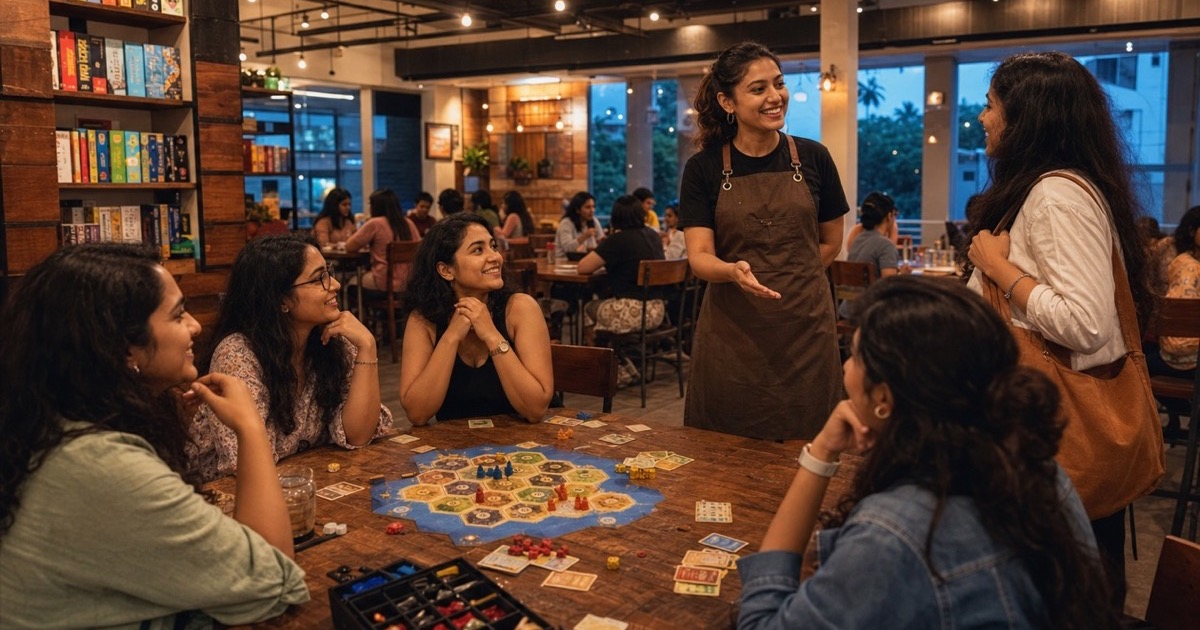
The substance-free positioning. The structured activity. The women founders running the scene. And the work that’s still left to do.
Start with our board game meetup scene in India (2026) field guide for cities, pricing, and first-timer etiquette; this article goes deeper on why the format works as a safe third space for women showing up alone.
A Story That Doesn’t Get Told Often Enough
In July 2018, the Hindustan Times reported that clubs on M-G Road in Gurugram had begun turning away unaccompanied women — citing a “no single women” policy in the wake of police raids. Women showed up at venues only to be told they couldn’t enter unless they could produce proof of being married, accompanied by a husband. As one woman quoted in the report observed, restricting women’s mobility didn’t improve safety — it just punished women for trying to exist in public.
That story sits in the background of every Indian woman who has tried to figure out where to spend a weekend evening on her own.
It’s also the unspoken context for one of the most interesting things to have happened in Indian urban social life in the last few years: the quiet emergence of board game meetups as one of the few public, structured, mixed-gender weekend spaces where Indian women can show up alone and feel safe doing it.
This blog is about that shift. Why it’s happening. Who’s behind it. What attendees are saying. And what still needs work.
The Substance-Free Frame Wasn’t an Accident
When HSRmeetups in Bengaluru calls itself “the largest substance-free meetup community in Bangalore — with guaranteed safety,” that language isn’t marketing fluff. It’s a deliberate response to feedback the founders received from women, college students, and recent transplants who wanted a weekend social option that didn’t involve a bar, a club, or alcohol.
The pricing model encodes this — ₹275 flat entry plus ₹50–99 F&B credit, no alcohol service at most venues, dedicated Game Masters who walk you through games. Look closely at the public-facing copy of nearly every successful Indian meetup, and the same pattern emerges:
- The Fun Boardgames describes itself as Absolutely Beginner-Friendly and Introvert-Friendly — language that women repeatedly cite in reviews as the reason they tried it.
- Victory Point Board Games positions itself as family-friendly and welcoming for solo attendees, with regulars helping newcomers learn rules.
- Hyderabad Board Gamers Club posts an explicit Code of Conduct on its Meetup page.
- The Boardgame Den on Church Street has a wheelchair-accessible venue and consistently appears in reviews from solo female travellers as a place that felt safe.
This is not subtext. It’s the actual product positioning. And it works.
Why It Works: The Structural Reasons
Read across enough attendee reviews — Tripadvisor, Yappe, Zomato, Instagram, travel blogs — and the same structural advantages keep coming up for women who attend solo.
1. The activity is structured. A bar requires you to do the social work yourself — start conversations, navigate strangers, manage unwanted attention. A board game table assigns roles, gives you something to do with your hands, and turns “talking to a stranger” into “playing Avalon with a stranger.” The structured task removes most of the discomfort that makes solo socialising hard for women.
2. There’s no alcohol expectation. A woman at a bar by herself is read in one way. A woman at a board game table by herself is read in another. The substance-free framing eliminates a whole category of social pressure and ambiguity in one stroke.
3. The Game Master acts as a third party. Most meetups have at least one dedicated host whose entire role is to match new attendees to tables and teach rules. This third party isn’t romantic, isn’t predatory, isn’t selling anything — they’re just making sure you’re playing. The presence of a Game Master functions as informal safety infrastructure.
4. The crowd skews early-evening. Most meetups run 5 PM to 11 PM, not midnight to 4 AM. The vibe of a 7 PM weekend evening is fundamentally different from the vibe of a 1 AM dance floor. For women navigating public transport or autos home, this matters enormously.
5. The community is repeat-visit, not one-night. Bars optimise for one-time customers. Meetups depend on regulars. That changes the social contract — strangers know they’ll see each other next Saturday, which raises the cost of behaving badly. The repeat-visit nature self-polices the room.
6. The activity itself produces conversation that isn’t gendered. A Catan trade negotiation, a Codenames clue, a Wingspan engine — none of these conversation starters depend on flirtation, performance, or gendered scripts. Reviews from women consistently cite this as the most freeing thing about the format.
The Voices Themselves
In the attendee reviews I’ve read across platforms covering Bengaluru, Mumbai, Hyderabad, Pune, and Chennai meetups, certain types of comments from women appear repeatedly. Paraphrased patterns:
- The woman who relocated to Bengaluru for work and didn’t know how else to meet people without dating apps. Found a meetup. Now goes weekly.
- The college student in Hyderabad who tried Get on Board Cafe with her sister and found it more fun than the local pub scene she’d been avoiding.
- The 30-something professional who explicitly mentioned not wanting “another night at a bar” and finding a substance-free meetup felt like a different kind of weekend.
- The traveller from outside India who picked The Boardgame Den specifically because it appeared in solo-female-friendly travel listings.
- The woman who cited the Game Master by name as the reason she felt comfortable her first night.
These aren’t unicorn reviews. They’re a pattern. And the pattern is significant enough that meetups that lean explicitly into solo-women-friendly positioning consistently outperform meetups that don’t.
The Women Building the Scene
It’s not just attendees. Some of the most important meetup and board game infrastructure in India is being built by women founders — and that fact alone matters in shaping the culture of the rooms they run.
Mansi Shah — The Boardgame Den, Bengaluru. Founder of one of India’s most-reviewed and highest-rated board game venues. Grew her weekend attendance from 15–20 players in 2019 to over 350 today. The Boardgame Den consistently shows up in solo-female-traveller travel guides for Bengaluru — partly because Mansi has built a venue with the structural features (Metro proximity, indoor lighting, daytime hours, host presence) that make solo visits work. See our Bangalore board game nights (2026) page for listings.
Tanushri SN — Roll the Dice, Bengaluru. Quit a software engineering career at Logica and Global Edge Software to revive traditional Indian board games. As covered by The Better India and The Hitavada in late 2025, Roll the Dice now reaches over 10,000 families across India and runs monthly meetups that draw attendees aged six to ninety. Tanushri’s venture demonstrates that Indian board game culture isn’t only an import — heritage games can build women-led communities too.
Sireesha — Get on Board Cafe, Hyderabad. Co-founder, alongside her husband Bhujang, of India’s largest board game café by inventory. Personally mastered all 700 games at opening — a fact named directly in reviews. Reviewers consistently identify her by name as part of why the café feels welcoming, and her presence is one of the reasons Get on Board has built such a strong cross-gender attendance pattern. See Hyderabad board game nights (2026).
Beyond founders, women regulars at Bangalore Meeples, Hyderabad Board Gamers Club, and The Fun Boardgames have become informal de facto hosts at their respective groups — onboarding new women attendees, vouching for the safety of the room, and turning the meetup into self-sustaining social infrastructure.
This visibility matters. A board game scene where women run the venues, host the tables, and dominate the regulars list reads very differently — to a first-time solo female attendee — from one where women are guests in a room full of men.
The Indore Recommendation, and Why It Matters
In a Medium piece on interest-based communities in Indian cities, writer Radhika Mohta credits Ila Vyas — described as a full-time corporate lawyer, part-time culture enthusiast and board games lover — as the source of the Indore recommendations. Vyas is part of a growing pattern: women in tier-2 Indian cities who don’t have a major meetup community locally, but who are themselves becoming the connective tissue.
The women who could start the next wave of Indian board game meetups are often already doing the work informally — recommending venues, organising friend-group game nights, becoming the regulars who anchor a new community. The structural ingredients are in place. What’s missing in many tier-2 cities is one woman deciding to put a date on a calendar and post it. Our start a board game meetup in India playbook covers the venue, pricing, and marketing math.
The Honest Section: What’s Still Broken
It would be naive to write this blog as a celebration. The board game hobby globally has a documented history of being male-dominated, and women in board gaming spaces — including in India — still encounter problems that the substance-free framing alone doesn’t solve.
The over-explainer. Every Indian meetup has at least one — usually a man, usually well-intentioned, who explains rules to a woman regular as if she’s never seen the game. It’s annoying. It’s also persistent.
The competitive man who can’t lose to a woman. Reviewers across multiple platforms have mentioned uncomfortable moments around this dynamic. Modern meetups try to manage it informally by reshuffling tables; the better ones build a culture where the issue self-corrects.
The “I’ll teach you” framing as a flirtation script. A subset of regulars use the rule-teaching format as a way to corner solo female attendees. Established meetups counter this by having visible Game Masters do the teaching; newer meetups don’t always have this infrastructure in place.
Skewed gender ratios in heavy-strategy circles. Bengaluru’s specialist heavy-Euro meetups, Delhi’s Strategy Board Games meetup, and similar communities tend to skew male more heavily than the social-deception and casual meetups. The reasons are mixed — partly historical, partly cultural, partly recruitment-driven — but the imbalance is real.
The “we’re already inclusive” trap. Some organisers, asked about gender, will say their meetup is already inclusive because women attend. That’s not the same as having published a Code of Conduct, training Game Masters to spot uncomfortable dynamics, having a clear escalation path for an incident, or actively recruiting women to host. The infrastructure has to be explicit, not assumed.
A research paper published on core.ac.uk titled “Fair-Play: How Women Experience Sexism within Board Gaming Spaces” examined twelve women’s experiences in board gaming communities worldwide and documented how women navigate sexism and dismissal in male-dominated rooms. The Indian meetup scene is younger and more deliberately inclusive than many global counterparts, but it has not solved this problem. It’s still being solved, one venue at a time.
What Better Looks Like
For organisers, café owners, and attendees who want to make the meetup ecosystem genuinely better for women, the things that demonstrably work — based on what successful Indian operators have already done:
- Publish an explicit Code of Conduct. Hyderabad Board Gamers Club has done this. HSRmeetups references theirs explicitly. The presence of one signals seriousness; the absence of one is a yellow flag.
- Train your Game Masters. Not just on the rules of games — on what to do if a regular makes another attendee uncomfortable.
- Recruit women regulars actively into hosting roles. Free entry, library credit, or community recognition can be the incentive. Their presence at the door changes the room.
- Police behaviour visibly, gently, and consistently. A “let’s reshuffle the tables” intervention every now and then signals to the room what’s acceptable.
- Run dedicated all-women / women-led events occasionally. Many global communities — Board Game Babes HQ has 1,000+ members and runs women-only meetups — have used these as recruitment events into the broader mixed community. Indian meetups can experiment with the same.
- Show, don’t tell, the gender mix. Instagram photos with visible mixed-gender tables do more than copy that says “everyone welcome.”
- Choose venues with the basics right. Bright lighting, Metro proximity, washrooms that are clean and accessible — these aren’t nice-to-haves. They’re the operating system of a women-friendly venue.
Why This Matters Beyond Board Games
The board game meetup is one of a small handful of social formats in urban India that have managed to solve the structured-third-space problem for women. The others — running clubs, book clubs, certain art workshops, run clubs like Indiranagar Run Club or Soles of Bangalore, women-only sports communities like Sisters in Sweat — share the same DNA. A specific activity. A structured weekly time. A culture of repeat attendance. A founder who cares about who shows up.
Indian women have been told for decades, in implicit and explicit ways, that their weekend leisure either happens at home or under male accompaniment. The board game meetup is one of the answers to that. Not the only answer. Not a complete answer. But an answer that has demonstrably worked for a meaningful number of women in Bengaluru, Hyderabad, Mumbai, Pune, and increasingly elsewhere.
The data isn’t enough to claim victory. But it’s enough to claim that something real is happening, that the women who built it know what they’re doing, and that the women who are still on the fence about showing up alone to their first meetup should know — based on the actual reviews of hundreds of women who went before them — that it’s the right call.
The Single Sentence Version
If you’re a woman who has been waiting to attend a board game meetup but hasn’t, the answer from hundreds of women across India is: go alone, RSVP in advance, pick a venue that publishes its Code of Conduct, and tell the host you’re new the moment you walk in. By the second game, you’ll forget why you were nervous.
If you’re an organiser, the answer is: the women-friendly meetup isn’t a niche — it’s the default, you just have to build it on purpose.
Are you a woman regular at an Indian board game meetup, an organiser working on these issues, or someone running a women-led tabletop community in India? The follow-up edition of this blog will feature your voice — reach out with details.
Related reading
- Board game meetup scene in India (2026) — The field guide this article builds on: cities, pricing, games, and first-timer etiquette.
- Board game nights in India (2026) — Pillar hub with city event guides from Ahmedabad to Goa.
- Start a board game meetup in India — Organiser playbook for building women-friendly infrastructure from scratch.
- Board game nights in Bangalore — Where Mansi Shah’s Boardgame Den and the densest women-friendly meetup scene live.
- Board game nights in Hyderabad — Get on Board Cafe and Hyderabad Board Gamers Club listings.
Leave a Reply