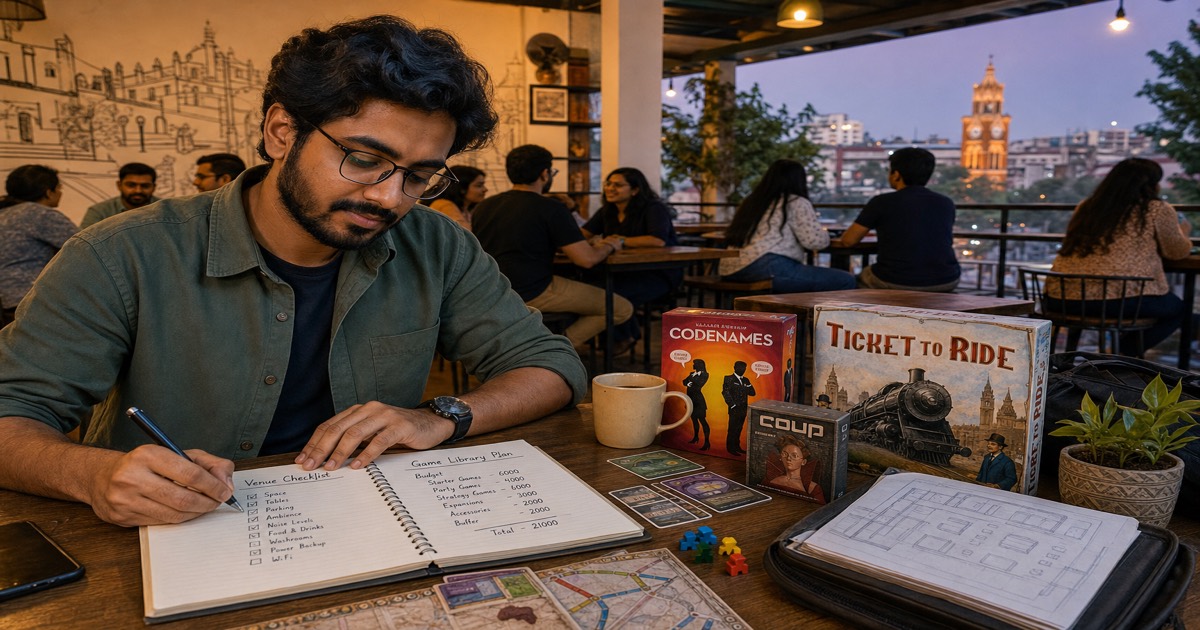
For the would-be organiser—especially in tier-2 cities where the scene hasn’t taken root yet. Six decisions in order: format, venue, pricing, library, marketing, running the night. Plus 2026 trends, common mistakes, and the six-month flywheel.
From picking a venue to building the right starter library to getting your first 20 strangers to show up. A field-tested how-to guide for the would-be organiser.
Already attending meetups? Read our companion field guide to India’s board game meetup scene (2026). For live event listings, start with board game nights in India.
Why Now Is the Right Time
If you’ve been to a board game meetup in Bengaluru, Mumbai, Hyderabad, or Pune in the last 18 months and walked away thinking “I could run this in my city,” the data agrees with you.
Bengaluru alone now has at least 8 actively running communities, with The Boardgame Den on Church Street growing from 15–20 weekend players in 2019 to over 350 today, and Now Boarding Cafe in Jayanagar reporting a 50–75% footfall surge since 2022. Hyderabad’s Get on Board Cafe stocks 1500+ games and clocks 2,400+ reviews averaging 4.80 stars. The Pune Strategy Board Games group has been running weekly meetups for years. India’s board games market is growing at a CAGR of 8.60%, projected to reach USD 3.80 billion by 2033—and meetups are quietly the fastest-growing slice of that.
But here’s the actual reason to start one: most Indian cities still don’t have a regular, well-run board game night. If you’re in Indore, Lucknow, Coimbatore, Bhubaneswar, Kochi, Ahmedabad, Chandigarh, or any tier-2 city that doesn’t show up on the Bengaluru–Mumbai–Delhi axis—you’re not late. You’re early.
This blog is a working playbook for what to do next.
Step 1: Decide What Kind of Meetup You’re Running
Before you pick a venue, pick an identity. The four most common formats in India right now:
The Drop-In Café Model. You partner with a café that gives you a recurring slot. Attendees pay a flat entry fee (₹250–500), often redeemable on F&B. The Boardgame Den, HSRmeetups, and The Fun Boardgames all use variations of this. Best for: lower-effort starts, predictable cash flow, leveraging an existing F&B space.
The Strategy Club Model. Invite-only or RSVP-required, focused on heavier games, smaller groups. Delhi Strategy Board Games Meetup is the archetype—Terraforming Mars, Agricola, Brass Birmingham, no beginner energy. Best for: serious gamers in metros where there’s enough density for a niche audience.
The Social Deception Night. Headlined by Blood on the Clocktower, Secret Hitler, Werewolf, or Avalon. Hyderabad Board Gamers Club runs popular BOTC nights with this format. Best for: cities where social-first meetups will draw bigger crowds than strategy-first.
The Free / Donation-Based Hobbyist Group. Pune Strategy Board Games and Bangalore Meeples both run free, BYO (Bring Your Own) game models—attendees just order at the café. Best for: building loyalty and community over revenue.
Pick one to start. You can layer the others later. Most successful organisers chose a lane in year one and only diversified after a hundred sessions.
Step 2: Pick the Right Venue
The venue makes or breaks the meetup. What seasoned organisers consistently optimise for:
- Tables. Real ones. Round or square, ideally 4–6 person size, with hard surfaces (no wobbly stools, no low coffee tables). A venue with five usable tables seats 20–30 people comfortably.
- Lighting. Bright enough to read card text. Most “cosy” cafés fail this test.
- Acoustics. A loud social deception table next to a Wingspan table ruins both. Look for venues with some sectioning or alcoves.
- Power outlets and washrooms. Sounds basic. Half the venues you’ll consider don’t have enough of either.
- F&B with reasonable margins for the venue. The café needs you to be profitable. If your 25 attendees order one chai each over four hours, you won’t be invited back.
- Metro / parking access. Solo attendees take public transport. Bengaluru meetups in Indiranagar, Koramangala, Church Street, and HSR Layout thrive partly because of metro proximity.
- Owner buy-in. The single most important factor. A café owner who genuinely likes the idea will hold the slot for you on bad-attendance nights. One who’s just renting space will drop you the moment a private booking pays more.
How to pitch a café: walk in on a weekday afternoon (not evening), ask for the manager, show them three things—your existing WhatsApp group size (even if it’s just 20 people), a sample event flyer, and an example F&B revenue model from a similar meetup. Most café partnerships in India start with the organiser doing math on a napkin.
Step 3: Get the Pricing Right
There are three pricing models working in India right now. Each has a clear use case.
Model A — Free entry, F&B order at venue. Bangalore Meeples runs this on Thursdays; the café benefits from full tables, you benefit from zero overhead. Works only if attendees actually order food. The minute a table of six nurses three teas for four hours, the model breaks.
Model B — Flat entry, no F&B included. ₹275–400 is the Bengaluru sweet spot in 2026. Victory Point charges ₹300, The Boardgame Den ₹400, The Fun Boardgames ₹299. This is the easiest model to understand and the easiest to scale.
Model C — Entry + F&B credit. HSRmeetups runs ₹275 + ₹50–99 F&B cover. Board Game Company runs ₹899 early-bird with ₹300 F&B credit. This is the cleanest model for the venue: it guarantees minimum spend per head while still feeling like a deal to the attendee.
Whatever you pick, publish it clearly. Hidden charges destroy first-impression reviews faster than anything else.
Step 4: Build Your Starter Game Library
This is the section the would-be organiser obsesses over and gets wrong. The biggest mistake: buying too many heavy games. A meetup library is not a personal collection. It needs to handle:
- A room with a 5:1 newcomer-to-veteran ratio
- Tables churning every 30–60 minutes
- Variable player counts (2 to 10 per table)
- Players who didn’t read any rulebook beforehand
You want 15–25 games to start. Below is the recommended starter library, organised by what each game does for your meetup, with the practical decision-making details for each.
A. Quick Teaches (Your High-Turnover Workhorses)
These are your rotating fill-ins. Tables open and close fast. Buy these first.
- Codenames — 2–8+ players · Ages 10+ · 15–30 min · Easy · ~₹1,500–2,000. The most-used game at Indian meetups. Two teams, spymasters give one-word clues. Scales from 4 to 12. Use it when: a big group arrives all at once and you need to seat 8 people in one game immediately.
- Just One — 3–7 players · Ages 8+ · 20 min · Very easy · ~₹1,800–2,200. Cooperative word-clue game; Spiel des Jahres 2019 winner. Warm, low-pressure, perfect for shy first-timers.
- Love Letter — 2–6 players · Ages 10+ · 20 min · Easy · ~₹1,200–1,500. 16-card deduction game in a tiny box. Teaches in 60 seconds. Pull it out during the awkward “we just arrived” minute.
- Skull — 3–6 players · Ages 10+ · 20 min · Easy · ~₹1,800–2,200. Bluffing with coasters. Deceptively deep. Cult favourite.
- Dobble (Spot It!) — 2–8 players · Ages 6+ · 15 min · Very easy · ~₹800–1,200. Find the matching symbol. Works for absolutely everyone. The “icebreaker before the icebreaker.”
- Sushi Go Party! — 2–8 players · Ages 8+ · 20 min · Easy · ~₹2,500–3,000. Card drafting; scales to 8 cleanly. The light filler that doesn’t feel light.
B. Social Deception (Your Headliner Draws)
This category will likely become your biggest crowd-puller. Indian meetups have repeatedly reported that social deception games sell out faster than anything else.
- Avalon / The Resistance — 5–10 players · Ages 13+ · 30 min · Easy-Medium · ~₹1,500–2,000. Loyalists vs Spies. The cleanest social deception entry point. Use it when: you have a mix of new players and veterans and you need a game that works for both.
- Coup — 2–6 players · Ages 13+ · 15 min · Easy · ~₹800–1,200. Bluffing with two hidden roles. Fast, brutal, replayable. Buy two copies.
- One Night Ultimate Werewolf — 3–10 players · Ages 8+ · 10 min · Easy · ~₹1,500–2,000. Each game is ~10 minutes. Lets you squeeze in three rounds with rotating groups in 30 minutes.
- Secret Hitler — 5–10 players · Ages 17+ · 45 min · Easy-Medium · ~₹2,500–3,500. Darker theme. Run this once the crowd skews older.
- Saboteur — 3–10 players · Ages 8+ · 30 min · Easy · ~₹1,200–1,500. Dwarves and sabotage. Cheap, scales well.
- Blood on the Clocktower — 5–20 players · Ages 16+ · 60–90 min · Medium-Heavy · ~₹15,000–20,000 (full kit). The premium social deduction draw at Indian meetups. Heads up: requires a dedicated storyteller and a learning curve. Don’t buy this in month one. By month six, it will become your flagship event.
C. Gateway Games (For First-Timers Who Want to Try “Real” Modern Board Games)
- Ticket to Ride: Europe — 2–5 players · Ages 8+ · 30–60 min · Easy · ~₹3,800–5,000. The most reliable gateway in the world. If you only buy one mid-weight game, buy this.
- Carcassonne — 2–5 players · Ages 7+ · 30–45 min · Easy · ~₹2,500–3,500. Tile-laying classic. Calmer than Catan, faster than Ticket to Ride.
- Kingdomino — 2–4 players · Ages 8+ · 15 min · Easy · ~₹2,000–2,500. 15-minute games with genuine strategy. The “quick win” gateway.
- Splendor — 2–4 players · Ages 10+ · 30 min · Easy-Medium · ~₹2,500–3,500. Gem-collecting engine builder. Easy to teach, deep choices. Beloved at meetups.
- Azul — 2–4 players · Ages 8+ · 30–45 min · Easy-Medium · ~₹3,500–4,500. Beautiful, tactical, calm. Works for tables that don’t want chaos.
D. Mid-Weight Strategy (Your Saturday Night Workhorses)
- Catan — 3–4 players · Ages 10+ · 60–90 min · Medium · ~₹3,500–4,500. The trade-table is the actual game. Still a meetup staple.
- 7 Wonders — 3–7 players · Ages 10+ · 30 min · Medium · ~₹4,000–5,000. The only mid-weight game that scales to 7 in 30 minutes. Indispensable.
- Wingspan — 1–5 players · Ages 10+ · 40–70 min · Medium · ~₹5,500–7,000. Beautiful and beloved. A bit long for fast-rotating meetups; pull it out for regulars on quieter evenings.
- Dominion — 2–4 players · Ages 13+ · 30 min · Medium · ~₹4,000–5,000. The original deck-builder. Choice-paralysis-prone for new players, but worth it.
E. Heavy Euro (For the Deep-End Crowd)
Buy only after month six, when you know which regulars actually want these.
- Terraforming Mars — 1–5 players · Ages 12+ · 120 min · Heavy · ~₹6,000–8,000. The Delhi heavy-strategy crowd’s favourite.
- Brass: Birmingham — 2–4 players · Ages 14+ · 60–120 min · Heavy · ~₹7,000–8,500. Currently ranked #1 on BoardGameGeek. Now Boarding Cafe stocks games at this price point.
- Castles of Burgundy — 2–4 players · Ages 12+ · 90 min · Heavy · ~₹4,500–6,000. Dice-placement classic. A specialist’s favourite.
F. India-Made Games (Worth Stocking for Cultural Relevance)
- Shasn — 2–5 players · Ages 14+ · 90–180 min · Medium-Heavy · ~₹3,500–5,500. The political strategy game from Memesys Lab. Triggers great table conversation.
- Mantri Cards — 2–8+ players · Ages 8+ · 20 min · Very easy · ~₹500–800. Top Trumps with 100 Lok Sabha MPs. Cheap filler.
- Traditional Indian games (Pagade, Chowka Bara, Pallanguzhi) — Variable players · Ages 6–90 · 20–45 min · Easy · ~₹600–2,500 (handcrafted sets). Tanushri SN’s Roll the Dice in Bengaluru has built an entire monthly meetup format around these. If you want to differentiate from yet-another-Western-games meetup, stocking 2–3 of these is a real edge.
The Starter Library Math
For a brand-new meetup running 20 attendees per session, a working library costs roughly ₹40,000–60,000 for the first 15–18 games. Skip the heavy Euros for now—they’re for a later phase. If you want a bare-minimum starter pack to test the model, ₹15,000–20,000 buys you Codenames + Coup + Avalon + Ticket to Ride + Splendor + Sushi Go + Just One + Love Letter + 2 copies of Dobble. That’s enough.
Where to buy in India: Boardgamesindia.com, Bored Game Company, Desi Board Games, and Amazon India (verify seller). Used copies from Facebook Marketplace and Reddit’s r/IndianGaming community can shave 30–50% off your library cost.
Step 5: Market the First Event
You don’t need a brand strategy. You need 12 people to show up the first time.
Where to post first:
- Meetup.com — for indexability and casual searches. ₹0 to start.
- Instagram — the actual discovery layer in 2026. Set up a handle, post one nice photo of the venue plus three sentences of pitch. Use the location tag aggressively.
- WhatsApp group — your real community lives here. Start with a friendly group link, set basic rules, post the event there.
- Reddit — r/IndianGaming, r/<yourcity>, r/india for the first event.
- Local Facebook groups — older audience but still works in tier-2 cities.
What to put in the first post:
- Date, time, exact venue (with Google Maps link)
- Entry fee (or “free, just order at venue”)
- Beginner-friendly disclaimer (“no experience needed, we’ll teach you”)
- A photo. Real venue, real games, real people if possible.
- One sentence on the vibe. The Fun Boardgames calls itself “Absolutely Beginner-Friendly and Introvert-Friendly”—this language works.
What seasoned Indian organisers have done that works:
- Cross-post each event 3–4 times across platforms
- DM 10 people personally before each early meetup
- Bring your own friends to the first 2–3 events (a half-empty room kills future attendance)
- Reply to every Instagram comment for the first six months
Step 6: Run the Night
The first hour, you’ll be running around. Plan for it. A working playbook:
30 min before start: Arrive at venue. Spread games visibly on a “library shelf” or main table. Pay the venue for any pre-agreed costs.
Start of event: Greet every person by name as they arrive. Ask if they’re new. If yes, ask: how many in your group, how new are you to board games, do you have a game in mind?
Match-making: Place new attendees with at least one regular per table. Veterans will teach. Don’t seat four total newcomers together—nobody will know the rules.
Rule-teaching: Most modern games can be taught by playing the first turn live. Don’t read the rulebook aloud. Demonstrate.
Mid-event: Walk the room every 30 minutes. Refill drinks, check who’s leaving soon (so you can backfill their seat).
End of event: Take one group photo. Post it that night. Tag people who consented. Share the next event date in the WhatsApp group within 24 hours.
Trends Worth Building Into Your Meetup
A few patterns from 2026 that newer meetups should explicitly design for:
1. Substance-free positioning works. HSRmeetups markets itself as Bengaluru’s largest substance-free meetup community. This single positioning choice unlocks audiences—women, students, sober professionals, recent transplants—who would never go to a bar.
2. Game Masters are non-negotiable. Every successful Indian meetup has 1–3 named or unnamed “Game Masters” who teach rules. If you can’t be everywhere, recruit two regulars in month 2 to be your floor hosts. Pay them in free entry or game library credit.
3. Heritage Indian games are an open lane. Tanushri SN’s Roll the Dice draws ages 6 to 90 by reviving Pagade, Chowka Bara, and Navakankari. Almost no urban Western-game meetup is doing this. If you’re in a tier-2 city, this could be your differentiation.
4. Hybrid formats are rising. Board Game Company in Bengaluru offers Blood on the Clocktower, D&D, and quizzing in the same venue. Modern meetups are blurring into “tabletop and social” rather than pure board games.
5. WhatsApp first, Instagram second, Meetup.com third. This is the reverse of what most new organisers do. Trust the order.
Common Mistakes (Avoid These)
- Mistake 1: Buying too many heavy games up front. A library full of Terraforming Mars and Brass Birmingham looks impressive but doesn’t get played for months.
- Mistake 2: Skipping the venue partnership conversation. “Can we just play in your café?” gets you booted after one bad night. A written or verbal agreement on slot, table reservation, and minimum F&B works.
- Mistake 3: Letting one over-competitive person dominate the vibe. Every meetup has one. Don’t tolerate them ruining new attendees’ first impressions. A polite “this table is for new players” works.
- Mistake 4: Inconsistent scheduling. If you say “every Saturday at 6 PM,” be there every Saturday at 6 PM, even when only three people RSVP. Consistency is what builds a community over a year.
- Mistake 5: Charging too much in month 1. Start cheap or free. Raise prices once you have a regular crowd.
- Mistake 6: Hosting in a cramped or noisy venue. A second-floor café room with five tables beats a famous cafeteria with bad acoustics every time.
The 6-Month Flywheel
What success looks like at sustainable scale, based on the organisers who’ve actually built it:
- Month 1: 8–15 attendees, mostly friends-of-friends. Lots of teaching, lots of one-time visitors.
- Month 2–3: A core of 4–6 regulars emerges. Instagram followers cross 100. WhatsApp group is active mid-week.
- Month 4–6: First wave of “I bring my friends now” returnees. Attendance averages 20+. You can experiment with themed nights (BOTC, heavy strategy, party night).
- Month 6–12: Second venue, second weekly slot, or both. Some attendees start hosting their own side meetups under your brand. The Game Master rota becomes a real thing.
- Year 2+: You’re Victory Point at 8 years, or The Boardgame Den growing from 20 to 350.
That’s the actual arc.
The Final Thought
Every organiser featured in this guide started with one event and one venue. Rohith Dabbiru started Victory Point alone eight years ago and now runs four meetups a week. Mansi Shah at The Boardgame Den went from 15–20 weekend players in 2019 to 350+ in 2025. Tanushri SN left a software engineering career to build Roll the Dice. Bhujang and Sireesha at Get on Board mastered all 700 games at their café before they opened the door.
You don’t need any of those things to start. You need a venue, ten WhatsApp contacts, six or seven games, and a Saturday evening you’re willing to give up for the next six months.
Start small. Show up consistently. The flywheel does the rest.
Related reading
- India’s board game meetup scene (2026) — Attendee field guide: cities, games, etiquette, and what to expect when you walk in alone.
- Board game nights in India (2026) — Pillar hub with city event pages to study before you launch.
- Perfect gateway board games (2026) — Core titles for your starter library shortlist.
- Carcassonne review (2026) — A calm gateway pick that teaches fast at new-player tables.
- Best family board games in India (2026) — Useful if you plan all-ages or mixed-family meetup formats.
Running a meetup in a city not yet covered in India’s board game ecosystem? Drop your details and the next edition of this guide will include you.
Leave a Reply