India crowned its first official Catan National Champion in 2024 — and he flew to Germany to play the world. Here’s how the championship circuit actually works, who’s winning, where the qualifiers happen, and how you get from your kitchen table to a seat at the Worlds.
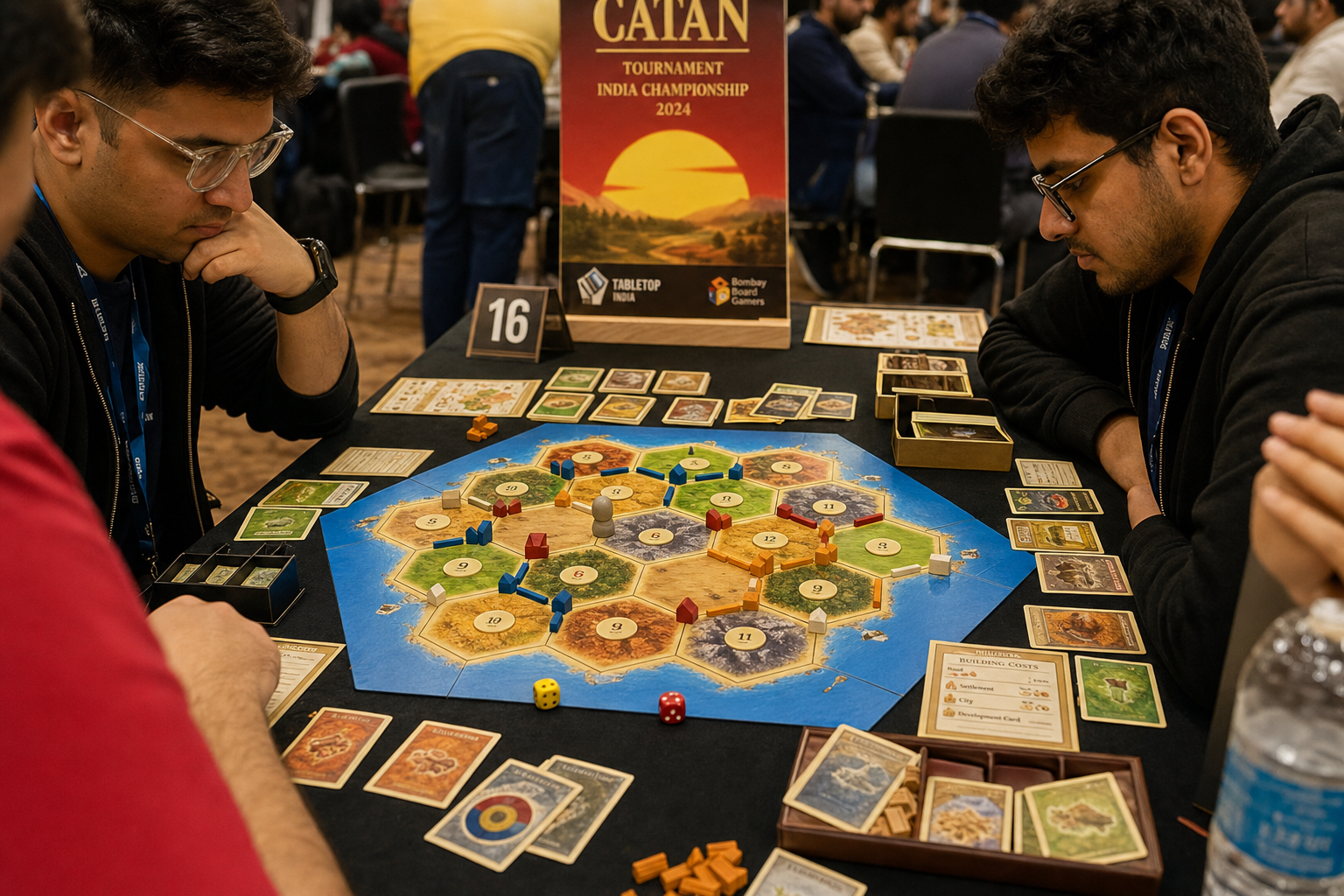
For years, Catan in India lived on coffee tables and in college hostels — the game your friend insisted on teaching you, the one where someone always refuses to give up wheat and a “friendly” robber ends a friendship. Fun, social, a little cutthroat. But not, you know, serious.
That changed in December 2024.
At Dublin Square in Phoenix Marketcity, Mumbai, Funskool — Catan’s official Indian publisher — ran what was billed as India’s first-ever official CATAN National Championship. Players who’d fought through qualifiers in four cities sat down for a single-elimination finale. When the last settlement was built, Shobhit Kasera of Kolkata walked away as India’s inaugural national champion. A few months later, he was in Stuttgart, Germany, representing India at the 2025 Catan World Championship against the best players from 60 countries.
A hobby game grew a ladder to the world stage — and most Indian gamers still don’t know it exists. This guide fixes that.
Why Catan, of all games?
Plenty of games get played competitively. Few are built for it the way Catan is. The reason it became the flagship of India’s organized board gaming is worth understanding before you decide to compete.
Catan sits in a sweet spot: simple enough that a newcomer learns it in 20 minutes, deep enough that the best players consistently beat the rest over many games. There’s luck — the dice giveth and the dice taketh — but across a tournament’s multiple rounds, skill wins out. That combination is exactly what a fair competition needs: low barrier to entry, high skill ceiling.
It also has the one thing most board games lack in India: an official, global organized-play system. Catan Studio and Catan GmbH run a worldwide championship structure with standardized rules, national programs, and a biennial World Championship. When Funskool brought that framework to India, it didn’t have to invent a competitive scene from scratch — it plugged India into an existing global ladder. That’s why Catan, not some other excellent game, is the one with a national champion and a flight to the Worlds.
The India Catan National Championship: how it actually works
The Indian program mirrors the global Catan structure, adapted to a handful of major cities. Here’s the pathway, based on the most recently run cycle.
Step 1 — Regional Qualifiers (four cities)
The road begins with Regional Qualifiers held in Delhi, Mumbai, Kolkata, and Bengaluru. These are open events — you don’t need a ranking or an invitation, just registration and residency in India.
At each qualifier, the format follows official Catan tournament rules:
- Every participant plays three games.
- Players are ranked by, in order: number of wins, then total victory points, then cumulative percentage of points scored per table. (That last tiebreaker rewards consistency — you want to score a big share of the points at every table you sit at, not just win one blowout and limp through the rest.)
The top finishers from each regional advance. In the 2024 cycle, that meant the top 4 from Delhi and Bengaluru and the top 8 from Mumbai earning invitations to the national finals — a structure that reflects where the player base is densest.
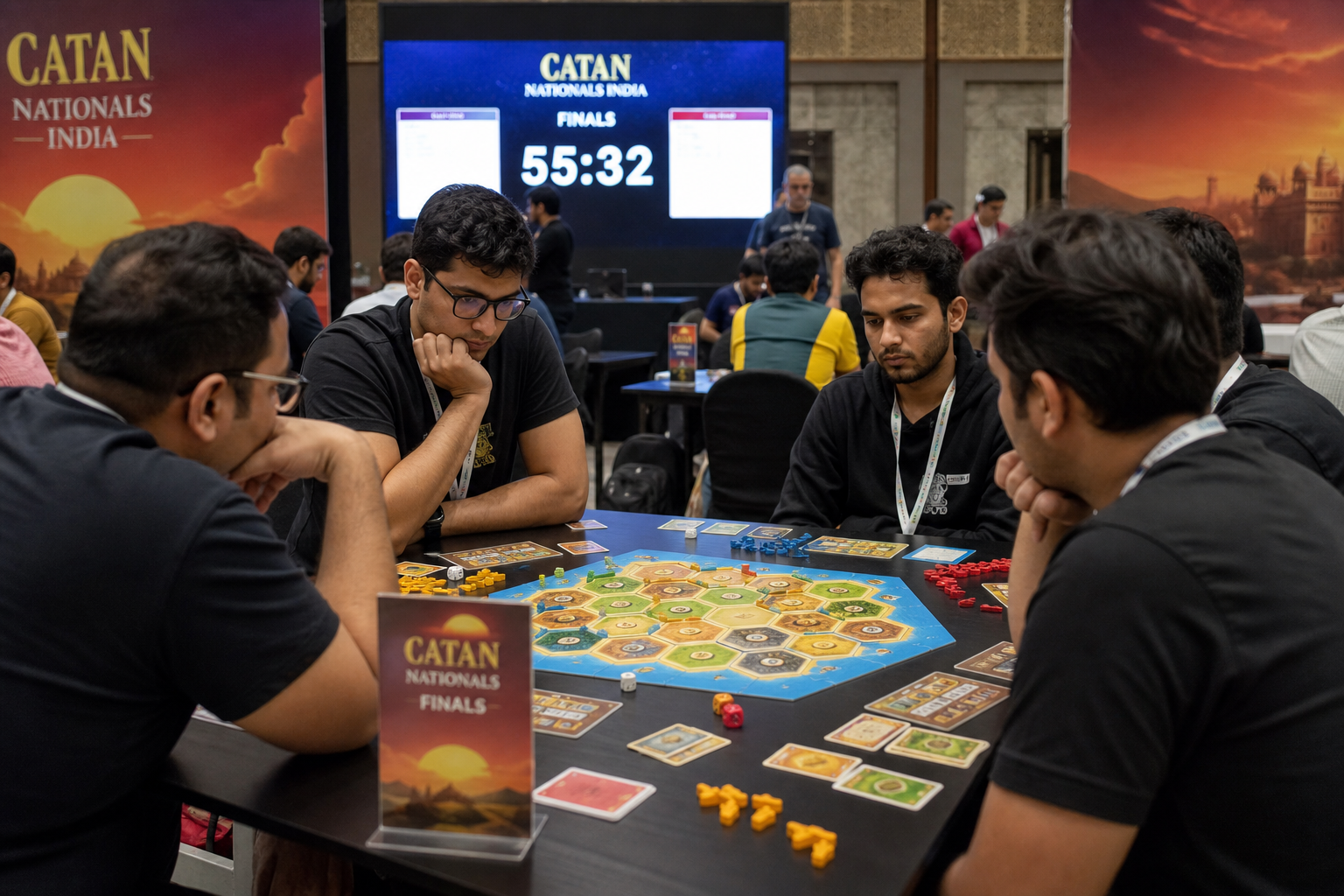
Step 2 — The National Championship (Mumbai)
The qualifiers feed a 16-player National Championship, hosted in Mumbai in partnership with Meeplecon, India’s largest board game convention. It’s a two-round, single-elimination event — win your table, advance; lose, you’re out. No second chances, no aggregate scoring to hide behind. One bad game and a clever rival ends your run.
The winner is crowned India CATAN National Champion.
Step 3 — The World Championship
This is the part that elevates the whole thing from “big tournament” to “genuine pathway.” Every two years, India’s national champion is sent to the Catan World Championship. Shobhit Kasera did exactly that — winning in Mumbai in December 2024, then competing in Stuttgart in April 2025, where he placed 60th in a field drawn from 60 countries.
The Worlds itself is brutal and elegant: on day one, every player plays four rounds against rotating opponents, ranked by wins, total victory points, and points percentage. The top 16 advance to the semifinals. The next World Championship is scheduled for 2027, location to be announced — which is the prize the next Indian champion will be chasing.
The fine print worth knowing
- You must be a resident of India and at least 18 years old, with ID or proof of residence (something as simple as a utility bill to an Indian address).
- The program runs under official Catan organized play, so the rules are the global standard — useful practice if you ever want to play internationally.
- Indian program queries have run through Mohit Goel of Meeplecon; general organized-play questions go to Catan Studio.
The championships and events to know
“Catan championships in India” isn’t a single event — it’s a small ecosystem with tiers. Here’s the lay of the land.
| Event | What it is | Where | Stakes |
|---|---|---|---|
| India CATAN National Championship | The official national title | Finals in Mumbai (via Meeplecon) | Winner represents India at the Catan World Championship |
| Regional Qualifiers | Open feeder tournaments | Delhi, Mumbai, Kolkata, Bengaluru | Top finishers advance to Nationals |
| Meeplecon Catan events | The convention that hosts the nationals + side tournaments | Phoenix Marketcity, Kurla, Mumbai | Direct line into the official circuit |
| Café & community tournaments | Casual-to-competitive local events | Bengaluru, Kolkata, Delhi NCR and others (board game cafés, community groups) | Practice, prizes, and a feeder culture; some online via Colonist.io |
| Catan World Championship | The global title | International (next: 2027) | World Champion |
A note on that fourth row: below the official structure sits a healthy layer of café and community-run Catan tournaments — events at board game cafés and through city gaming communities, sometimes played in person, sometimes online on platforms like Colonist.io with prizes like a board game to take home. These aren’t part of the official qualification chain, but they’re where most players sharpen up, find their group, and decide they want to take a real shot at a regional qualifier. Think of them as the club circuit beneath the national league.
The people and partners behind it
Three names make this scene run:
Funskool — India’s leading toy manufacturer, which, under license from Asmodee International, manufactures and distributes Catan in India and sponsors/organizes the national championship. Their involvement is what gives the event official standing rather than fan-run informality.
Meeplecon — India’s first and largest board game convention (running since 2017), which hosts the national finals and folds Catan into a weekend that draws thousands of gamers. Co-organizer Mohit Goel is the contact point for the Indian Catan program.
Catan Studio / Catan GmbH — the global rights-holders whose organized-play framework India slots into, and who send national champions to the Worlds.
That combination — a serious publisher, a flagship convention, and a global governing body — is exactly the trio most competitive board game scenes in India lack. It’s why Catan is ahead.
The trends worth watching in 2026
From “first-ever” to “expected annual.” The 2024 national championship was explicitly India’s first. The story to watch is whether it hardens into a fixture with a predictable calendar — the moment players can plan their year around qualifier dates is the moment the scene matures from event to institution.
The two-year heartbeat. Because the Worlds is biennial (next in 2027), the Indian championship runs on a rhythm: a national title in the cycle that feeds Worlds carries a flight to the global stage, raising the stakes and the field’s intensity. Expect the pre-Worlds cycles to draw the strongest entries.
Cities are the unit of growth. With qualifiers concentrated in Delhi, Mumbai, Kolkata, and Bengaluru, the competitive map mirrors India’s metro gaming communities. The interesting question is whether tier-2 cities get qualifiers next — Pune, Hyderabad, Ahmedabad and Chennai all have active scenes that could support one.
The café-to-championship funnel. The real engine isn’t the finals; it’s the steady drip of café and community tournaments creating players who eventually want a bigger arena. As board game cafés multiply, the qualifier pool deepens.
New edition, new meta. The Worlds in Stuttgart was the first to debut Catan’s 6th Edition. As the new edition settles in, expect strategy discussion — opening placements, the wheat-vs-ore debate, robber etiquette — to get louder in Indian groups too.
What the community sounds like
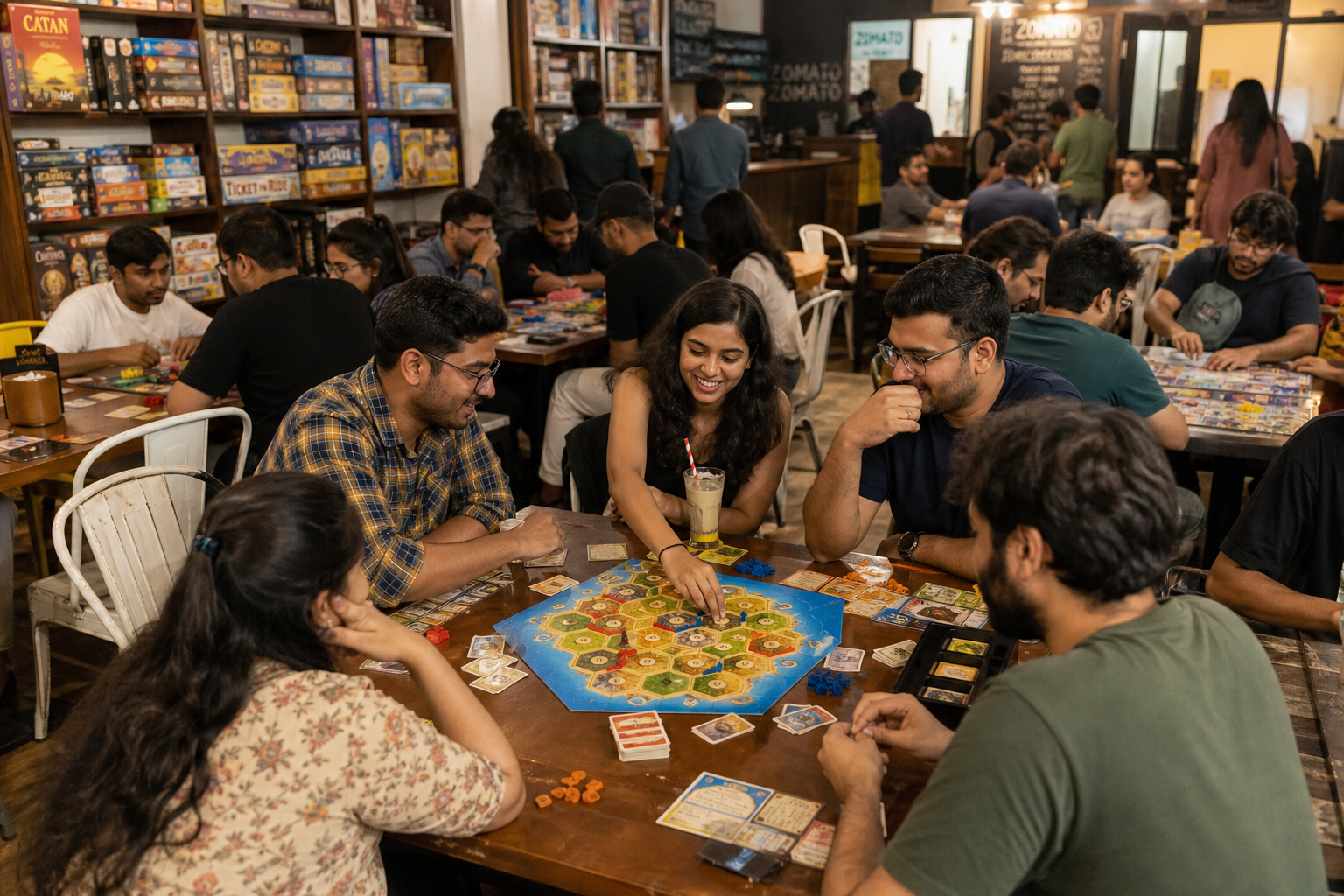
You don’t have to look hard to find the energy. India’s board gaming communities are sizeable and loud online — the Board Gaming Community | Delhi NCR account alone counts followers in the tens of thousands, and Catan tournaments pop up regularly in city listings, from Hard Rock Cafe Bengaluru hosting a Catan tournament to Kolkata organizers running beginner-friendly events where, as one listing pitched it, if you’ve never played Catan, now is your chance — and winners take a board game home.
The champion’s own words capture the vibe better than any analysis. Reflecting on his win, Shobhit Kasera said his journey with the game had been “nothing short of amazing,” that winning in India was “a dream come true,” and that playing in Mumbai “was such a blast.” That’s the tone of the whole scene right now — competitive but joyful, ambitious but still rooted in the simple pleasure of a good game with strangers who become friends.
So, can you compete? (Yes — here’s the move)
The barrier is lower than “national championship” makes it sound. There’s no ranking requirement to enter a regional qualifier — just residency, age, and the nerve to sit down.
A realistic path for an enthusiastic player:
- Get sharp at your local level. Play regularly — a board game café, a city community, or online on Colonist.io. Learn the tournament scoring mindset: consistent high placements beat occasional blowouts.
- Watch for the next Regional Qualifier in Delhi, Mumbai, Kolkata, or Bengaluru. Follow Meeplecon and Funskool’s channels and the major city gaming communities so you catch the announcement.
- Play three clean games. Wins first, then maximize your victory points and your share of the table. Place high and you advance.
- Survive single elimination in Mumbai. Two rounds, no safety net. Win, and you’re the national champion.
- If it’s a Worlds cycle, pack your bags. The next World Championship is in 2027.
India spent decades treating Catan as a casual pastime. As of 2024, there’s a real title to win, a real ladder to climb, and a real flight to a world championship at the top of it. The boards have always been out. Now there’s a trophy at the end of the table.
New to the game or want to build your group first? Browse our gateway games guide, find your local scene through our Board Game Night India city pages, or read why Catan still divides players — then go settle some islands competitively.
Frequently Asked Questions
Is there an official Catan championship in India?
Yes. India has an official CATAN National Championship organized by Funskool (Catan’s licensed Indian publisher) in partnership with Meeplecon, India’s largest board game convention. It runs under the global Catan organized-play framework, and the national champion goes on to represent India at the Catan World Championship.
Who won the Catan National Championship in India?
Shobhit Kasera from Kolkata won India’s first official CATAN National Championship, held in Mumbai in December 2024. He went on to represent India at the 2025 Catan World Championship in Stuttgart, Germany, where he finished 60th in a field drawn from around 60 countries.
How do I qualify for the Catan championship in India?
You enter a Regional Qualifier held in one of four cities — Delhi, Mumbai, Kolkata, or Bengaluru. At each qualifier you play three games, ranked by number of wins, then total victory points, then your cumulative percentage of points per table. Top finishers from each regional advance to the 16-player National Championship in Mumbai.
Who can participate in the India Catan National Championship?
Participants must be residents of India and at least 18 years old. You should be able to prove residency with an official ID card or a piece of mail, such as a utility bill, sent to an Indian residential address. There is no ranking or invitation required to enter a regional qualifier.
Where is the Catan National Championship held in India?
The national finals are held in Mumbai, hosted alongside Meeplecon at Phoenix Marketcity, Kurla. The regional qualifiers that feed it are spread across Delhi, Mumbai, Kolkata, and Bengaluru.
When is the next Catan World Championship?
The Catan World Championship is held every two years. The last edition was in Stuttgart, Germany in April 2025, and the next is scheduled for 2027, with the location to be announced. India’s national champion from the relevant cycle earns the seat.
What is the format of the Catan National Championship in India?
The national finals are a 16-player, two-round, single-elimination event. The qualifying rounds before it use a multi-game format scored by wins, victory points, and points percentage, following official Catan tournament rules.
Are there smaller Catan tournaments in India?
Yes. Beyond the official championship, board game cafés and city gaming communities in places like Bengaluru, Kolkata, and Delhi NCR run their own Catan tournaments, some in person and some online via platforms like Colonist.io. These aren’t part of the official qualification chain but are a great way to practice and find a competitive group.
Related reading
- India’s board game trophy circuit (2026) — Full map of Catan, Scrabble, carrom and convention championships across the country.
- Board game nights in India (2026) — City guides to find local tables before you chase a trophy.
- Perfect gateway board games (2026) — Warm-up titles to sharpen before Catan qualifiers.
- Games board gamers love to hate — Why Catan still divides players.
Leave a Reply