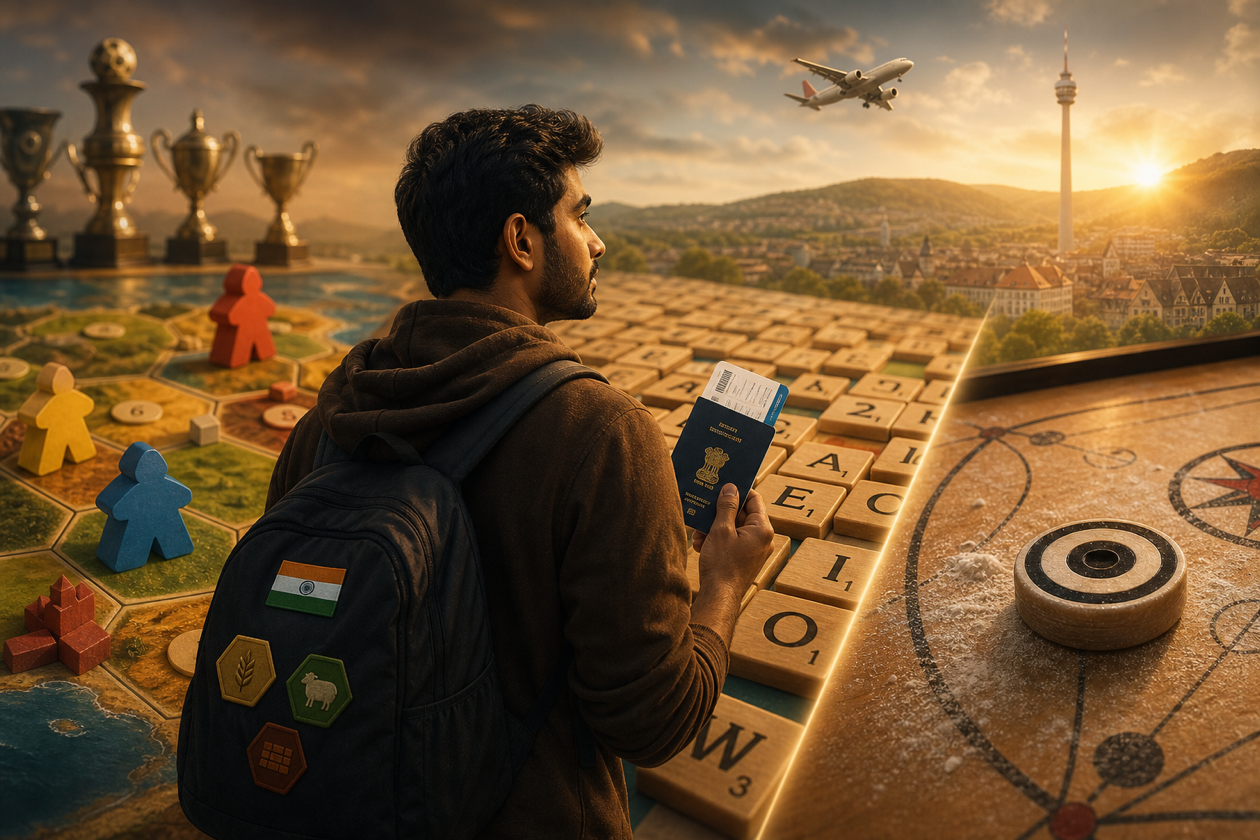
Catan nationals, the biggest Scrabble Open in the world, a 50-year-old carrom federation, and a convention floor where 6,000 people show up to roll dice. India’s competitive tabletop scene grew up while you weren’t looking.
There’s a moment that tells you a hobby has crossed over. For Indian board gaming, it wasn’t a product launch or a viral reel. It was watching Shobhit Kasera — a regular gamer who won a Mumbai tournament — fly to Stuttgart in 2025 to represent India at the Catan World Championship, finishing 60th against national champions from 48 countries.
That used to be unthinkable. For most Indians, “board games” meant Ludo on a Sunday, Snakes & Ladders at a cousin’s house, or the Monopoly box that started fights and ended friendships. Competition meant cricket. Strategy meant chess.
That picture is now badly out of date.
In 2026, India has a genuine, multi-layered board game championship circuit: official Catan nationals feeding into the world championship, the largest Scrabble Open on the planet, a carrom federation that’s been crowning national champions for nearly five decades, and conventions in Mumbai and Bengaluru where thousands compete across hundreds of titles in a single weekend. Whether you’re a Euro-game obsessive, a word-game grinder, or someone who’s quietly devastating on a carrom board, there’s now a trophy with your name’s shape on it.
Here’s the full map of where to play, when, and what it actually takes to compete.
Why this is happening now
A few currents converged. India’s modern board gaming community — the people who play Catan, Wingspan, and social deduction games rather than only the classics — has been compounding since the late 2010s, largely through city meetups and a handful of cafés. Conventions gave that scattered community a place to gather at scale. Once you put a few thousand enthusiasts in one hall, somebody inevitably says: let’s keep score.
At the same time, international organized-play programs (Catan being the clearest example) started treating India as a real territory with its own qualifiers and a seat at the world table, rather than an afterthought. And the traditional Indian games — carrom above all — have had formal national structures for decades, quietly running championships the modern hobby is only now rediscovering.
The result is a circuit with three distinct lanes. Let’s walk each one.
Lane 1: Modern strategy games — the convention championships
This is the newest and fastest-growing slice, and it lives mostly inside India’s big tabletop conventions.
Meeplecon — India’s oldest and largest board game convention
If the Indian scene has a flagship, it’s Meeplecon. Born in 2017, it has grown from roughly 300 gamers in year one to thousands by 2019, and it returned strong post-pandemic. The 2026 edition (its sixth) ran on 31 January – 1 February 2026 at Dublin Square, Phoenix Marketcity, Kurla, Mumbai, packing the floor with 200+ games, workshops, family zones, and — crucially — multiple tournaments running across the weekend.
What makes Meeplecon matter competitively:
- It hosts the official Catan India National Championship (more on that below), sponsored by Indian publishing partner Funskool and organized by the Meeplecon team.
- It runs mega-tournaments across popular titles plus a Corporate Board Game Championship, where company teams (the site name-checks the likes of HDFC) compete for a day — a clever on-ramp that turns office outings into competitive play.
- In 2026 it even folded in a MeepleCon Blitz chess tournament (1 February, two 7-round blitz events, ₹250 early-bird, ₹10,000 prize fund per event, run with CircleChess), with registration getting you free two-day convention access.
Bottom line: If you only attend one event a year and you live anywhere near Mumbai, this is the one. Entry-level passes have historically been affordable (single-day passes in the few-hundred-rupee range in earlier years), and game instructors are on hand to teach newcomers, so you can compete even if you’re walking in cold.
TTOX — “India’s Biggest Tabletop Games Convention”
The other heavyweight is TTOX, which bills itself as India’s premier modern-strategy tabletop convention. Its Summer Edition ran 19–21 June 2026, three days, 10 AM to 10 PM each day, with a library of 1,000+ games and a stated 4,000+ gamers having passed through its doors to date.
TTOX’s competitive and community hooks:
- Tournaments across crowd favorites plus free-to-play zones, indie designer showcases, and playtesting tables.
- The TTOX Awards — a four-stage, community-driven awards process that collects nominations from players, designers, publishers, reviewers, and creators across India, then culminates in a live final round at the convention. It’s less a “championship” than a People’s Choice for Indian tabletop, and it’s explicitly designed to spotlight original Indian games with global potential.
- Passes were tiered (single-day, weekend, and a three-day “Champions” pass), with kids 6 and under free.
Bottom line: TTOX leans into discovery and the designer ecosystem as much as competition. If you want to play broadly, meet creators, and dip into tournaments without the pressure of a feeder-to-worlds structure, TTOX is the friendlier sandbox.
The Catan India National Championship — the one with a world-championship ticket
This is the crown jewel of the modern lane, because it’s a real pipeline to a world title.
Here’s how the structure works, based on the most recent published cycle:
- Regional Qualifiers in major cities — recent editions ran qualifiers in Delhi, Bengaluru, Kolkata, and Mumbai. Each player plays three games, ranked by official Catan rules (wins, total victory points, then cumulative percentage of points per table).
- National Semifinals/Finals in Mumbai — the top finishers from each regional (e.g., top 4 from Delhi and Bengaluru, top 8 from Mumbai in the 2024 cycle) advance to a 16-player, single-elimination national event hosted at Meeplecon.
- The World Championship — every two years, the national champion is sent to the Catan World Championship. India’s 2024 champion, Shobhit Kasera, competed at the 2025 Worlds in Stuttgart; the next Worlds is slated for 2027.
A few important details for anyone eyeing this:
- You must be a resident of India and 18+, with ID/proof of residency.
- It’s run through the official Catan organized-play system, so the rules and rankings are the global standard — good practice if you ever want to play internationally.
- Contact for the Indian program has run through Mohit Goel of Meeplecon.
Bottom line: This is the most “serious” competitive board game pathway in the country right now — a clear ladder from a city café table to a world stage. If you’re a Catan player with ambitions, build your year around the qualifier calendar.
Lane 2: Word games — Scrabble’s surprisingly deep ecosystem
If the modern lane is the loud newcomer, Scrabble is the quiet veteran that’s been running a proper national circuit for years — and India is genuinely world-class at it.
The Scrabble Association of India (SAI) and the national title
The Scrabble Association of India unites players across Mumbai, Pune, Bangalore, Chennai, Hyderabad, Delhi, Goa, Vadodara, and Kolkata, and runs a full calendar of rated tournaments. Historically, the Indian Nationals (long known as the Bayer Indian Nationals, held in Mumbai) is the event whose winner is declared National Champion, with India’s representatives to the World Scrabble Championship decided on the basis of ratings and national results.
SAI maintains its own rating system and title structure — National Grandmaster (NGM), National Master (NM), and National Expert (NE) — so there’s a formal ladder of achievement beyond a single trophy. Membership is inexpensive (around ₹500/year, with life membership options), which keeps the competitive scene unusually accessible.
The KSSA Indian Open — the biggest Scrabble tournament on Earth
Here’s the headline that surprises people: India hosts what’s described as the world’s largest Scrabble tournament. The KSSA Indian Open, run by the Karnataka State Scrabble Association, is a four-day event — the 2026 edition ran 23–26 January at the MuSigma campus, Whitefield, Bengaluru.
What it looks like in practice:
- SAI- and WESPA-rated, meaning results count toward both Indian and world rankings.
- Multiple divisions by rating — Division A (1650+), B (1300–1649), C (below 1300), and an Enthusiast/Corporate division strictly for unrated newcomers (a one-day, six-game format on the Sunday). There’s a true on-ramp here for first-timers.
- A genuine festival atmosphere — the final day in 2026 coincided with Republic Day, with players turning out in ethnic wear.
Beyond the Indian Open, the SAI calendar is dotted with character-rich events: the long-running Goa Open (its 20th edition ran 17–19 April 2026), the Deccan Challenge in Hyderabad, the Pune Open, and even a leisurely Scrabble-in-the-hills retreat in Himachal’s Tirthan Valley (24 games over four days, gaming-meets-vacation).
A notable 2026 milestone: for the first time, a government body — the Sports Development Authority of Tamil Nadu — has begun engaging with competitive Scrabble in the state, a sign the game is being taken seriously as a mind sport.
Bottom line: Scrabble is the most mature competitive board game ecosystem in India — rated, tiered, internationally connected, and welcoming to beginners through dedicated enthusiast divisions. If you love words, this is the most fully-built ladder you can climb, and you can start as an unrated player and still have a real event to enter.
Lane 3: Traditional games — carrom’s five-decade head start
While the modern hobby was being born, one classic Indian board game already had a national federation, ranking tournaments, and international champions: carrom.
The All India Carrom Federation (AICF)
The All India Carrom Federation, registered in Madras (Chennai) in 1977, is the national governing body for carrom and India’s representative in the International Carrom Federation. It’s a serious operation:
- 31 state/UT associations and 15 affiliated institutions, the largest being the Maharashtra Carrom Association.
- Recognized by the Indian Olympic Association (1997) and the School Games Federation of India (1996).
- It sanctions six to seven national-level tournaments a year and has run 90+ national championships across age categories — sub-junior, cadet (under 12), junior, youth (under 21), and senior — plus the All India Federation Cup and various ranking and prize-money events. State bodies like the Maharashtra Carrom Association run their own state-ranking circuits that feed the nationals.
India dominates the world stage
This isn’t a participation story — India wins. At the 8th ICF Cup in Pune (2019), India took both the men’s and women’s team titles, and Indian players like S. Apoorva have completed hat-tricks of international singles titles across world championships and world cups. When the world’s best carrom players gather, the trophies tend to come home to India.
Bottom line: If you grew up flicking a striker across a powdered board, there’s an entire formal competitive structure waiting for you — with age-group nationals, state ranking tournaments, and a credible path to a world championship where India is the team to beat.
A quick-reference table of India’s board game championships
| Championship | Game | Governing body / organizer | Where | When (2026) | Path to worlds? |
|---|---|---|---|---|---|
| Catan India National Championship | Catan | Catan Studio / Meeplecon (Funskool partner) | Regional qualifiers (Delhi, Bengaluru, Kolkata, Mumbai) → finals Mumbai | Tied to Meeplecon cycle | Yes — Catan World Championship (next 2027) |
| Meeplecon tournaments & Corporate Championship | Many | Meeplecon | Phoenix Marketcity, Kurla, Mumbai | 31 Jan – 1 Feb | Hosts Catan nationals |
| TTOX Awards & tournaments | Many | TTOX | India (Summer Edition) | 19–21 Jun | Community awards |
| KSSA Indian Open | Scrabble | Karnataka State Scrabble Association | MuSigma, Bengaluru | 23–26 Jan | Yes — WESPA-rated |
| Indian Nationals (National Champion) | Scrabble | Scrabble Association of India | Mumbai (traditionally) | Per SAI calendar | Yes — World Scrabble Championship |
| Goa Open | Scrabble | SAI circuit | Porvorim, Goa | 17–19 Apr | Rated event |
| Senior/Junior/Sub-Junior Nationals & Federation Cup | Carrom | All India Carrom Federation | Rotating host states | 6–7 events/year | Yes — ICF Cup / World Championship |
Dates reflect the most recently published editions and can shift year to year — always confirm on the organizer’s official channel before booking travel.
The trends worth watching
Pulling back from the individual events, a few patterns define where Indian competitive tabletop is heading in 2026:
Conventions are the new arenas. Rather than standalone tournaments, the modern competitive action is bundling into big weekend conventions (Meeplecon, TTOX) that combine play, commerce, and competition. It’s efficient and it’s social — you come for the trophy and stay for the 1,000-game library.
The corporate channel is real. Meeplecon’s Corporate Board Game Championship is a genuinely smart growth lever. Companies are using tabletop competition as team-building, which funnels a steady stream of new players — many of whom catch the bug and return as hobbyists.
Cross-pollination with chess. The MeepleCon Blitz chess event, run with chess organizers and covered by chess media, shows the board-and-mind-sport worlds blending. India’s post-Gukesh, post-streaming chess boom is spilling energy into the broader tabletop scene.
Government recognition is creeping in. Carrom has had Olympic-association recognition for decades; now a state sports authority is engaging with Scrabble. The line between “hobby” and “mind sport” is blurring, and official backing tends to bring funding, school programs, and legitimacy.
Homegrown games want a global stage. The TTOX Awards explicitly aim to spotlight Indian-designed games with international potential. Combined with the visibility of Indian titles like Shasn, there’s a growing ambition not just to play the world’s games competitively, but to export India’s own.
What the community is saying
Scroll the social feeds and the throughline is energy, not nostalgia. Meeplecon’s recap content captures it well — organizers describe the hall as coming alive with “dice rolled, strategies clicked, and the room came alive,” the kind of language that reads less like marketing and more like genuine post-event high. The convention’s own framing leans into the universal hook every gamer recognizes: that “just one more game?” energy that turns a casual afternoon into a closing-time stand-off.
What’s striking in the player chatter is how often first-timers feature. Meeplecon’s site tells stories of attendees who “wandered in by chance” and discovered a world of games they didn’t know they were missing, or who waited years through the pandemic to return to India’s one-of-a-kind convention. On the Scrabble side, the KSSA Indian Open’s reputation as a four-day, ethnic-wear-on-Republic-Day, world’s-biggest gathering travels by word of mouth and YouTube stream (Let’s Play Scrabble has been building high-quality coverage of the top tables). The signal across platforms is consistent: this is a scene that’s confident enough to compete hard and welcoming enough to keep pulling new people to the table.
So, should you enter something?
Yes — and the on-ramps are gentler than the word “championship” suggests.
- Total beginner? Walk into Meeplecon or TTOX. Instructors will teach you, and you can play tournaments casually before committing to anything serious.
- Word nerd? Join SAI (it’s cheap), and enter the Enthusiast division at the KSSA Indian Open or a local Open. You’ll be playing rated games within a season.
- Catan obsessive? Watch for the next regional qualifier in Delhi, Bengaluru, Kolkata, or Mumbai. Three games and a good day could put you on the road to Mumbai — and eventually a world championship seat.
- Carrom shark? Find your state association (Maharashtra’s is the most active), enter a state ranking tournament, and work toward the AICF nationals in your age group.
India spent decades thinking of board games as either children’s fare or pub classics. In 2026, there’s a trophy circuit with real ladders, real rankings, and real flights to world championships. The boards were always here. Now there’s a scoreboard.
Find your nearest scene through our Board Game Night India city guides, or start your own with our meetup playbook — then go win something.
Related reading
- Board game nights in India (2026) — Pillar hub with city event guides to find local tables before you chase a trophy.
- How to start a board game meetup in India — Organiser playbook for building the community layer that feeds championship circuits.
- India’s board game meetup scene (2026) — Field guide to the weekend culture where many future champions first learned the rules.
- Perfect gateway board games (2026) — Warm-up titles to sharpen before convention tournaments and Catan qualifiers.
- Magnus Carlsen, chess & kids — How India’s mind-sport boom is spilling into tabletop, from blitz chess at Meeplecon to strategy games.
Leave a Reply