Rohith Dabbiru. Mansi Shah. Tanushri SN. Avikant Bhardwaj. Bhujang and Sireesha. Vale Prasadh. The names behind India’s biggest board game communities — and the lessons they’ve earned from running them, year after year.
This is the organiser’s angle on the boom you’ve read about elsewhere. For the attendee field guide, start with our India board game meetup scene (2026) page; for the how-to playbook, see how to start a board game meetup in India.
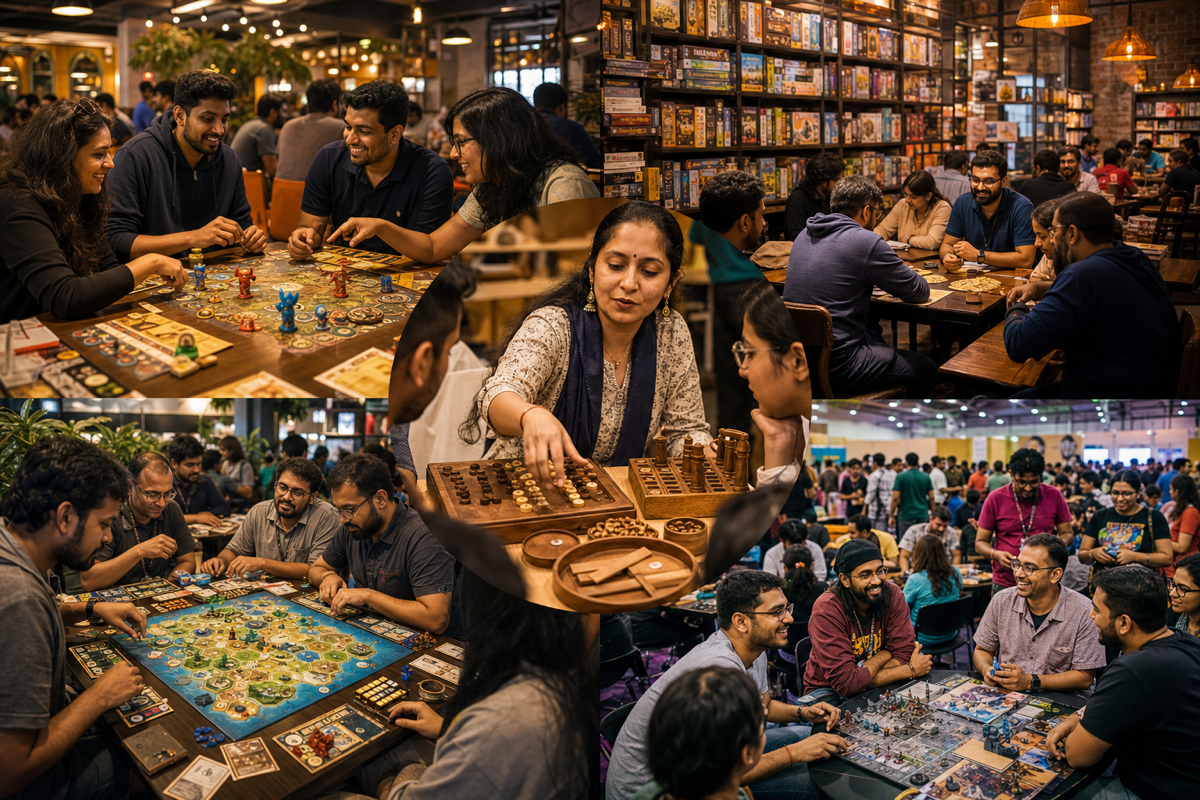
The Quiet Revolution Has Names
Most articles about India’s board game boom talk about it like weather — something that’s just happening, a generational shift, a vibe. It isn’t. It’s a small number of people who chose, one venue and one Saturday at a time, to keep showing up. Eight years for some. Eleven for others. Five years of quiet steady building before the rest of the country caught on.
This blog is about them. The founders, the café owners, the meetup organisers, the woman in her mid-forties who quit her tech job to revive ancient Indian games. Their stories don’t read as inspirational arcs. They read as a series of practical decisions — what to charge, which café to partner with, how to handle a difficult regular, what to do when only six people show up — repeated enough times that an industry took shape.
What follows is what they’ve said, what they’ve built, and what newer organisers can learn from how they did it.
Rohith Dabbiru — Victory Point Board Games, Bengaluru
What he built: Victory Point Board Games, founded in 2017. Four weekly meetups across Koramangala, HSR Layout, and Indiranagar. A community that draws 23-to-40-year-olds to games like Blood on the Clocktower and Dune: Imperium. A WhatsApp community of over 4,000 members. The grandparent of the Bengaluru meetup scene. See also our Bangalore board game nights (2026) listings.
The arc: Started small in 2017. Doubled events from two a week to four as demand grew. As reported by Deccan Herald in May 2025 and New Karnataka the same month, attendance has climbed steadily through the post-pandemic years, with the strongest growth coming after 2022 — exactly when Indian urban life was emerging from lockdown and looking for offline socialising.
The lessons embedded in eight years of running this:
- Consistency beats scale. Running the same meetups in the same localities for eight years built trust no marketing budget could. A reliable Saturday slot is more valuable than a viral Instagram post.
- Newbie-friendly is a positioning, not a slogan. Victory Point’s public description emphasises that veterans help newcomers learn rules. This single behavioural promise has been the engine of the community.
- Expansion happens by city pocket, not by venue. Running across Koramangala, HSR, and Indiranagar means attendees commute less. A meetup that asks attendees to cross Bengaluru twice a week will not survive.
- The age band matters. 23–40 isn’t accidental. It’s the slice of urban India with disposable income, time, and a desire for offline socialising. Optimise programming for them — late evenings, slightly heavier games, beer-and-snacks venues.
What organisers should steal: The decision to formalise four meetups a week across separate neighbourhoods. Running once a week in one venue is a hobby. Running four times a week across four areas is infrastructure.
Mansi Shah — The Boardgame Den, Bengaluru
What she built: The Boardgame Den on Church Street, Bengaluru. A 300+ game library that grew to over 350 games. Five-hour weekend sessions that bring together locals and travellers in equal measure. 5.0-star average across Tripadvisor and Viator. A weekly footfall that grew from 15–20 players in 2019 to over 350 today — a roughly 20x increase in six years.
The arc: Started running weekend sessions before the broader Bengaluru meetup scene had hit critical mass. Survived the pandemic gap. Now occupies prime real estate next to Church Street Metro Station inside the Purvankara Pavilion — possibly the most discoverable board game venue in India.
The lessons embedded in what she’s built:
- Library size is a moat. When you stock 350+ games, you’re no longer a meetup — you’re a destination. New attendees don’t need to know what to play; they’ll find something.
- Location is everything. Church Street + 50 metres from MG Metro Station + inside an existing co-working building (WeWork) means foot traffic comes to you. You don’t have to recruit it.
- Solo attendees are the highest-leverage audience. Reviews repeatedly mention solo travellers being matched into groups. Building infrastructure (hosts, table-matching) for solo attendees creates the warmest reviews, which then drive more solo attendees. It’s a flywheel.
- Cross-cultural mix unlocks Instagram virality. The Boardgame Den shows up on Tripadvisor and Viator because tourists discover it. Bengaluru-based locals see those listings and become curious. The international audience is unexpectedly a marketing channel for the local one.
What organisers should steal: The realisation that a board game venue, run well, isn’t a niche hobby space. It’s a tourism asset. List on Tripadvisor and Viator. Welcome international visitors. Let the cross-cultural energy do half the marketing.
Bhujang and Sireesha — Get on Board Cafe, Hyderabad
What they built: India’s largest board game café by inventory, with a stocked library that’s grown from 700+ games in 2021 to 1,500+ by 2024 to 3,000+ (per their Instagram) by 2026. Located in Jubilee Hills. A 4.80-star average across 2,400+ reviews. Featured by The News Minute as a phenomenon attendees were cancelling movie plans to attend. For Hyderabad events, see our Hyderabad board game nights (2026) page.
The arc: Started by a husband-and-wife team — Bhujang from an IT background, Sireesha previously an IQ enhancer in France. According to their interview with The News Minute, the café started as a Saturdays-and-Sundays room with friends, then a one-room business they were sceptical would work. Within 30 days of opening they were running 365 days a year.
The lessons embedded in their story:
- Mastering your own catalogue is the differentiator. Bhujang and Sireesha personally learned all 700 games at opening. Reviews consistently credit them by name. Most café owners don’t do this; it’s the single biggest moat between a great board game café and a mediocre one.
- Tiered learning curves work. Get on Board organises games into “Getaway games” (icebreakers), then Light Strategy, Medium Strategy, Heavy Strategy. By the time a regular reaches Heavy Strategy, they’re teaching others. The café has built a learning pathway, not a library.
- Hourly pricing is fine — but day passes change the math. Reviewers consistently note that buying a day pass made the visit feel like an investment in a long evening. Per-hour pricing alone caps how long people stay; day passes encourage stickiness.
- Owner presence is the brand. Reviews of cafés where the owners are absent skew lower. Reviews of Get on Board mention Bhujang and Sireesha personally. The owners are the product.
What organisers should steal: The decision to be physically present, teach games yourself, and let the founder-as-host be the marketing engine. You cannot outsource that energy.
Tanushri SN — Roll the Dice, Bengaluru
What she built: Roll the Dice — a venture that revives traditional Indian board games like Pagade, Chowka Bara, and Navakankari. Monthly meetups that draw attendees aged six to ninety. Approximately ₹2 lakh per month in revenue. Over 10,000 families touched across India. Handcrafted, eco-friendly game sets made with natural fabrics and sustainably sourced wood — no plastic.
The arc (as covered by The Better India and The Hitavada in October 2025): Tanushri holds a master’s in computer software engineering from BITS Pilani and worked at Global Edge Software and Logica before taking a career break. She started Roll the Dice in 2019 after years of the idea simmering. Her husband Shashishekhar, formerly at Cisco, joined her full-time in 2023.
Her framing of the work: Tanushri has described traditional Indian board games as living cultural threads, not relics. As she told New Karnataka, “People are seeking a break from their rushed routines.”
The lessons embedded in what she’s built:
- Heritage is an untapped lane. While dozens of meetups in India stock Catan and Codenames, almost none stock Pagade or Pallanguzhi. Tanushri found differentiation by going backwards in time rather than forwards.
- The 6-to-90 age range is a real moat. Modern board game meetups skew 22–45. Heritage games can draw children, grandparents, families — an audience the rest of the industry isn’t serving.
- Material choices are positioning. Plastic-free, handcrafted, naturally sourced — these aren’t just sustainability gestures. They’re a signal to a specific Indian middle-class consumer who values heritage and authenticity over slick packaging.
- Monthly cadence works for a heritage product. Roll the Dice runs monthly meetups, not weekly. Heritage games are an occasion. Western meetup gamers crave weekly novelty; heritage attendees come for the rare event.
What organisers should steal: The realisation that India’s board game scene is not just an import of the Western hobby. There’s an entire parallel category — traditional Indian games — waiting for someone to organise it. If you’re in a tier-2 city, this might be your edge. See also our best family board games in India (2026) guide for the cultural-revival context.
Avikant Bhardwaj — Now Boarding Cafe, Bengaluru
What he co-founded: Now Boarding Cafe in Jayanagar, Bengaluru. Two sessions daily Tuesday through Friday. Stocks heavier games like Castles of Burgundy and Brass: Birmingham, some priced at up to ₹8,000 — well beyond most casual cafés’ budgets.
The arc: Avikant has reported a 50–75% surge in footfall since 2022. Now Boarding sits in Jayanagar — not a typical board game hotspot — but has built a specialist crowd that travels for the heavier collection.
The lessons embedded in what he’s built:
- Specialising in heavy games is a defensible niche in a crowded city. Most Bengaluru meetups optimise for casual crowds. Now Boarding picked the deeper end and built loyalty in a smaller but committed audience.
- Mid-week sessions matter. Two sessions daily Tue–Fri is unusual. Most meetups are weekend-only. Mid-week sessions catch a different audience — work-from-home professionals, students, regulars who want a less crowded experience.
- Stocking expensive games is a statement, not a cost. A ₹8,000 game won’t pay itself back in single-session revenue. But it attracts the kind of customer who’ll buy a day pass and return weekly. The library is a marketing investment.
What organisers should steal: The decision to commit to a specialist niche when your city already has generalist meetups. Don’t be the fifth casual meetup. Be the first heavy-strategy room.
Vale Prasadh — Live The Game, HSR Layout, Bengaluru
What he built: Live The Game in HSR Layout. Over 600 games on the shelf. Themed strategy nights every alternate Friday. Slots that fill within hours of being posted.
The arc: Built a tighter, more curated programming model than the larger drop-in cafés. Themed nights — instead of “show up and pick a game” — create scarcity, urgency, and excitement around specific evenings.
The lessons embedded in what he’s built:
- Themed nights drive RSVP behaviour. A generic “Friday meetup” gets browsed. A “Friday Brass: Birmingham Night” gets booked. Constraints create demand.
- Alternate-Friday cadence allows depth. Themed strategy nights work because attendees know they’ll need to learn or revisit a specific game. A weekly themed night burns out fast; bi-weekly creates the right anticipation rhythm.
- Capacity caps are a feature, not a bug. When slots fill in hours, regulars learn to RSVP fast. That conditioning is exactly what builds a sticky core community.
What organisers should steal: The themed-night format. It transforms a meetup from “place I might go” into “event I have to be at.”
Meeplecon — Mohit Goel, Prashant Maheshwari, Karan Rawat
What they built: Meeplecon, India’s only board game convention. Started in 2017. The 2023 edition at Phoenix Market City in Mumbai featured 200+ board games, school and college tournaments, the first Corporate Board Game Championship, and the first-ever Indian Board Game Awards — sponsored by Cluedo from Hasbro India. For the wider trophy circuit, see our India board game championships (2026) guide.
The arc: Three founders (an IIT Bombay/IIM Ahmedabad grad, a Manchester Business School grad, and an IIT Kharagpur grad) decided in 2017 that India needed an actual convention. Eight years later, it’s drawn corporate partnerships, brand sponsorships, and inter-college tournaments.
The lessons embedded in what they’ve built:
- A convention is a flywheel for the entire ecosystem. Meeplecon doesn’t compete with weekly meetups; it amplifies them. Every meetup organiser, café owner, and publisher benefits from a single annual flagship event that legitimises the hobby.
- Corporate partnerships unlock scale. Cluedo/Hasbro sponsorship gives Meeplecon a budget that no community-run meetup could match. Brand partnerships in India work when the brand can showcase its games to a buying audience.
- Tournament formats convert casual players into spenders. A “Best Family Board Game” award or a “Corporate Championship” creates a competitive ladder that drives game sales, café footfall, and meetup attendance simultaneously.
What organisers should steal: The recognition that India needs more events at the convention scale, not fewer. If you’re past month 12 of running a successful local meetup, organising a one-day mini-convention in your city is the next move.
Patterns Across All Six
Read across these six profiles and the same lessons keep emerging:
1. Consistency over time is the only real moat. Every founder featured here has been doing this for 5+ years. The community trusts them because they keep showing up.
2. The founder is part of the product. Bhujang and Sireesha personally taught all 700 games. Rohith is at his own meetups. Mansi is the named founder reviewers see. Tanushri’s face is on Roll the Dice’s videos. The brand and the human are inseparable.
3. Specialisation beats imitation. Tanushri picked heritage. Avikant picked heavy strategy. Vale picked themed nights. Mansi picked tourism + library scale. None of them tried to be the same thing as the others — and that’s why they all succeeded.
4. The audience is younger and wealthier than they assumed. Reports across founders cite an age range of 23–40 with growing pre-teen and grandparent fringes. Disposable income, time off screens, and a hunger for offline socialising are the demand-side drivers.
5. Indian heritage is an open lane. Tanushri is the only major operator going after this — which means it’s wide open for anyone else who wants to combine modern meetup formats with traditional games.
6. The city you start in matters less than the city you commit to. Pune Strategy Board Games, Hyderabad Board Gamers Club, Chennai’s Boardgame Kingdom — none of these are Bengaluru, and all of them work. Density matters less than depth.
The Quote That Sums It Up
From Tanushri SN, on why the community has grown the way it has: “People are seeking a break from their rushed routines.”
That’s the macro story. Bhujang and Sireesha at Get on Board reported that attendees were cancelling movie plans to keep playing. Mansi’s venue grew 20x in six years because attendees brought their friends. Avikant’s Now Boarding doubled its footfall in three years. None of this is happening because board games suddenly got better. It’s happening because Indian urban life got more exhausting, and a handful of founders had quietly built the alternative.
Eight years from now, someone will write this same blog about the meetup you started this month — if you start it this month.
Related reading
- How to start a board game meetup in India (2026) — The practical playbook for venue, pricing, library math, and your first night.
- India’s board game meetup scene (2026) — The attendee field guide: show up alone, play, leave with friends.
- India board game championships (2026) — Meeplecon, Catan nationals, and the trophy circuit these founders helped legitimise.
- Board game nights in Bangalore (2026) — Event listings for the city where most of these founders built their communities.
- Best family board games in India (2026) — Heritage and family-table context for Tanushri’s Roll the Dice lane.
Want to add your founder story to the next edition of this guide? Send the details — the meetup, the city, the year you started, and one lesson you’ve earned the hard way.
Leave a Reply