Let’s be honest about something most parenting blogs won’t admit: roughly 80% of the “educational” games on Amazon in 2026 are not actually fun. They’re worksheets in a box. The kid plays once, the box goes on the shelf, the box never comes off the shelf, and three months later you’re donating it to a school fete.
The other 20% are extraordinary — games where the learning is so well-hidden that your kid will fight you to keep playing past bedtime. These are the best educational games for kids that are fun in 2026, and they’re what this list is about.
We’re skipping the picks that score high on “educational” but only fine on “fun.” If your six-year-old won’t ask to play it on a Tuesday evening with no prompting, it’s not on this list. Every game below has been pulled from BoardGameGeek’s “best with kids” data, parent threads on r/boardgames and r/BoardGamesIndia, and conversations with families whose kids actually play these games on rotation — not just dust them off for guests.
The structure is different from our umbrella best educational kids games guide, which is organised by age. This page is organised by type of fun — because what makes a game irresistible varies enormously by kid, and most “fun” educational lists ignore that.
The Fun Test: How We Picked These Games
A game made this list only if it cleared three bars:
- The kid asks to play it again — without adult prompting, within a week of first playing it. This is the only test that matters.
- The adult doesn’t groan when it’s suggested. Game nights that don’t bore the adults are game nights that actually happen.
- There’s a real cognitive skill being trained under the hood. Counting, memory, deduction, planning, vocabulary, spatial reasoning — something that matters.
Games that pass all three are rare. There are roughly 15 of them across the entire kids’ game market in 2026 that we’d recommend without hesitation. Here they are.
Laugh-Out-Loud Fun: Educational Games That Get Kids Cackling
The first category. These games trigger genuine belly laughs at the table while teaching motor skills, basic physics, and spatial reasoning. The fun is immediate — no warm-up curve.
1. Animal Upon Animal (Tier auf Tier)
/pic403502.jpg)
Age: 4+ · Players: 2–4 · Time: 15 min · Skill: Motor control, spatial reasoning, physics intuition
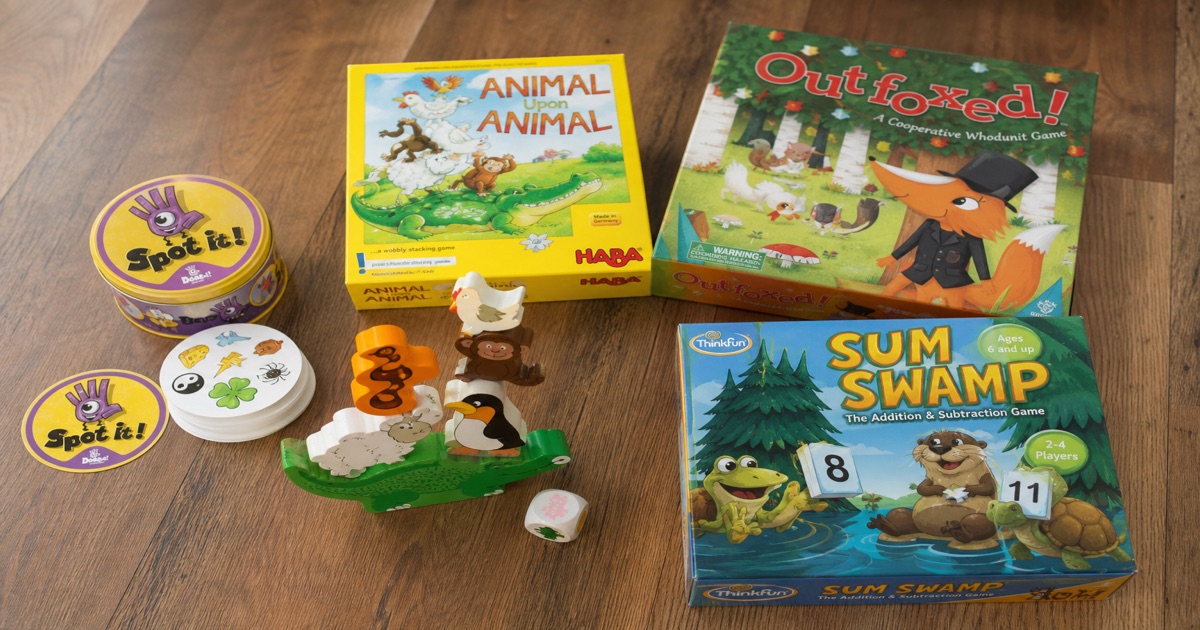
HABA’s wooden stacking classic. Players roll a die and try to balance increasingly absurd animals — hedgehogs, snakes, sheep, crocodiles — on a wobbling pile that always, always collapses at the worst moment. The toppling is the joke and kids never get tired of it. Genuine fine-motor and spatial-reasoning training disguised as physical comedy.
Why kids love it: Every collapse is a punchline. Every successful balance is a tiny triumph.
Buy: Amazon.in · Amazon US · BGG
2. ICE COOL
/pic3320017.png)
Age: 6+ · Players: 2–4 · Time: 30 min · Skill: Motor control, planning, physics
Flick penguins around a nested cardboard board, trying to collect fish while one penguin plays “catcher” trying to tag the others. Spiel des Jahres Kinderspiel 2017 winner. The penguins curve when you flick them right — physics in action — and the catching mechanic adds genuine slapstick. Six-year-olds laugh continuously. So do adults.
Buy: Amazon.in · Amazon US · BGG
3. Rhino Hero: Super Battle
/pic9267030.png)
Age: 7+ · Players: 2–4 · Time: 20 min · Skill: Dexterity, spatial reasoning, planning
A vertical card-stacking game where players build a wobbling skyscraper while tiny wooden superhero figures battle on top. The “Super Battle” version adds movement and combat to the original Rhino Hero formula. Towers collapse spectacularly. Kids genuinely cheer when their hero knocks an opponent off the building.
Buy: Amazon.in · Amazon US · BGG
4. Funny Bunny
Age: 4+ · Players: 2–4 · Time: 15 min · Skill: Counting, basic probability, anticipation
Carrot-pulling chaos on a brilliant 3D hill board. Players race their bunnies upward, but pulling a “wrong” carrot drops random bunnies through trapdoors. The 3D board is genuinely impressive and the random drops cause maximum giggling. Counting and turn-taking get sneaked in.
Buy: Amazon.in · Amazon US · BGG
Addictive Fun: Games Kids Beg to Replay (Over and Over and Over)
Games in this category have a “just one more!” quality. They finish quickly, they shuffle into a new game state easily, and the replay value is genuinely measured in hundreds of plays. Working memory, pattern recognition, and arithmetic get drilled in the background.
5. Spot It! / Dobble
Age: 6+ · Players: 2–8 · Time: 5–10 min per round · Skill: Visual processing speed, working memory, pattern recognition
Find the matching symbol between any two cards faster than anyone else. That’s the whole game. It plays in five minutes, finishes with someone screaming “I see it!”, and kids will run six rounds back-to-back before they get bored. Sold as Spot It! in the US and Dobble in India — same game. Every household with a 5-to-10-year-old should own a copy.
Why it’s addictive: The dopamine hit of finding the match is genuine. Kids chase it.
Buy: Amazon.in · Amazon US · BGG
6. Sushi Go!
/pic1900075.jpg)
Age: 8+ (works at 6 with the visual icons) · Players: 2–5 · Time: 15 min · Skill: Counting, set collection, light probability
Card drafting in a tin. Pass hands of sushi cards around, keep one each round, score combinations at the end. The art is gorgeous, the rules fit on three lines, and the game ends in 15 minutes — which means most kids will demand a second game immediately. Sushi Go Party! is the expanded version with more variety.
Buy: Amazon.in · Amazon US · BGG
7. Sum Swamp
Age: 5+ · Players: 2–4 · Time: 15 min · Skill: Addition, subtraction, odd/even
Roll two dice and an operation die, do the math, move your alligator across the swamp. Sum Swamp is the most-recommended first math board game on parenting forums in 2026 because it triggers an addictive “what number will I get next?” loop. Kids end up doing 40 sums in a session and have no idea they were practising. Genuine educational gold.
Buy: Amazon.in · Amazon US · BGG
8. Set
Age: 6+ · Players: 1+ · Time: 15 min · Skill: Pattern recognition, working memory, attribute logic
A pure pattern-recognition workout. Find three cards where every feature is either all the same or all different across four dimensions (colour, shape, number, fill). Set is brain-burning hard and somehow still addictive — kids and adults compete on level ground because the game rewards a specific kind of visual pattern intuition that doesn’t favour age.
Buy: Amazon.in · Amazon US · BGG
“Beat Your Parents” Fun: Educational Games Where Kids Genuinely Win
This category is special. Games where the kid can legitimately outplay an adult, often using skills (memory, dexterity, fast pattern recognition) that decline with age. The win feels earned. The fun comes from genuine triumph.
9. Memory / Concentration
Age: 3+ · Players: 2+ · Time: 10–15 min · Skill: Working memory, attention, recall
The classic. Flip cards, find pairs, win. Children genuinely outperform adults at Memory — the working-memory capacity for visual position is at its peak around ages 5–8. The look on a six-year-old’s face the first time they beat both parents at Memory is the reason this game has stayed in print for sixty years.
10. Patchwork
Age: 8+ (works at 6 with light help) · Players: 2 · Time: 25 min · Skill: Spatial reasoning, planning, opportunity cost
A 2-player Tetris-style quilting game. Players take turns buying fabric pieces and stitching them onto a personal quilt board. Kids genuinely beat adults at this — the spatial puzzle suits younger brains beautifully. Adults playing seriously will still lose to a focused nine-year-old. It’s wonderful.
Buy: Amazon.in · Amazon US · BGG
For more 2-player picks built around exactly this dynamic, see our best 2-player board games for 6 year olds guide.
11. Quoridor (or Quoridor Kid)
Age: 6+ (Kid version) · Players: 2 · Time: 15–20 min · Skill: Spatial planning, blocking, look-ahead reasoning
Move your pawn to the opposite side of the board while placing fences to slow your opponent. Pure abstract strategy with no luck. Kids who get hooked on Quoridor will out-think you within months. Gorgeous wooden production. A genuine engineering of frustration and triumph.
Buy: Amazon.in · Amazon US · BGG
Cooperative Fun: Games Where Winning Together Is the Whole Point
Cooperative games are the secret weapon of educational gaming. They sidestep loss-aversion completely, model collaborative problem-solving, and teach kids that adults are allies — not opponents. The fun comes from shared victory.
12. Outfoxed!
/pic2401324.jpg)
Age: 5+ · Players: 2–4 · Time: 20 min · Skill: Deduction, elimination logic, cooperation
A cooperative whodunit. Players work together to identify a pie-thieving fox using a tactile clue decoder — slot suspect cards in, see whether each one is innocent or guilty. The deduction is genuinely sound: kids learn to eliminate systematically. We’ve recommended this to dozens of families and watched the same scene unfold every time: kid huddled with parent, both whispering theories, both cheering when the fox is caught.
Buy: Amazon.in · Amazon US · BGG
13. Magic Maze Kids
Age: 5+ · Players: 1–4 · Time: 15 min · Skill: Spatial coordination, real-time thinking, cooperation
A real-time cooperative game where players steal magical objects from a witch’s mountain. Each player can only move characters in one specific direction — which means the table has to silently coordinate (eventually) to move characters around the maze. Brilliant for working memory and shared planning. Frantic in the best way.
Buy: Amazon.in · Amazon US · BGG
14. SOS Dino
Age: 5+ · Players: 1–4 · Time: 20 min · Skill: Cooperative planning, route optimisation
A cooperative dinosaur-rescue game. A volcano spews lava across the board (you flip tiles to track it) and players race to save four dinosaurs while collecting eggs. The theme is irresistible at five or six, and the planning required to save all four dinos is genuine strategic teamwork. Underrated and beautifully produced.
Buy: Amazon US (Loki / IELLO) · IGGames or Dice and Decks in India · BGG
Travel Fun: Educational Games That Fit in a Pocket
The last category — games small enough to live in a backpack, glove compartment, or restaurant bag. Long flights, train journeys, waiting rooms, hotel rooms. These games turn dead time into learning time without anyone noticing.
15. Story Cubes (Rory’s Story Cubes)
Age: 6+ · Players: 1+ · Time: 5–15 min · Skill: Narrative construction, vocabulary, speaking confidence
Nine dice. Fifty-four images. Roll all nine, then tell a story that uses every image you rolled. Genuinely the best speaking-and-storytelling tool we’ve encountered for ages 6–10 — and it weighs nothing. Sits in a backpack and works on a plane. The Voyages, Actions, and Mystery expansions are worth buying once your kid is hooked.
Buy: Amazon.in · Amazon US · BGG
Quick Comparison: Best Fun + Educational Games in 2026
| Game | Age | Type of Fun | Skill |
|---|---|---|---|
| Animal Upon Animal | 4+ | Slapstick | Motor + spatial |
| ICE COOL | 6+ | Slapstick | Motor + physics |
| Rhino Hero: Super Battle | 7+ | Slapstick | Dexterity + planning |
| Funny Bunny | 4+ | Slapstick | Counting |
| Spot It! / Dobble | 6+ | Addictive | Visual processing |
| Sushi Go! | 6+ (with help) | Addictive | Counting + sets |
| Sum Swamp | 5+ | Addictive | Math |
| Set | 6+ | Addictive | Pattern logic |
| Memory | 3+ | Beat-your-parents | Working memory |
| Patchwork | 6+ (with help) | Beat-your-parents | Spatial strategy |
| Quoridor Kid | 6+ | Beat-your-parents | Planning |
| Outfoxed! | 5+ | Cooperative | Deduction |
| Magic Maze Kids | 5+ | Cooperative | Coordination |
| SOS Dino | 5+ | Cooperative | Planning |
| Story Cubes | 6+ | Travel | Narrative |
“Educational” Games That Are NOT Fun (And Why)
A counter-list, because honesty matters. These games appear on a lot of “fun educational” lists in 2026 and they shouldn’t. Avoid these unless your kid has specifically asked for them:
- Most “math facts” card games sold by educational retailers. They’re flashcards with a colour scheme. Your kid will detect the worksheet underneath in about thirty seconds.
- Trivial Pursuit Junior. Trivia is not a kid-friendly mechanic. You either know it or you don’t, which means winning correlates entirely with how much your parents have prepped you.
- Most “spelling bee” branded games. Sounding out words is hard work even when packaged well. The competitive framing makes it worse.
- Mouse Trap. Hear us out: it’s a famous “STEM” game, but the setup takes 20 minutes, the contraption works approximately half the time, and the actual gameplay is trivial. The lesson is “Rube Goldberg machines are fun to set up” and ends there.
- Generic Snap or matching games at flea markets. The mechanic is fine; the production isn’t. Cards warp, kids lose interest, the box gets thrown out.
The unifying problem: each of these prioritises the appearance of educational value over the actual play experience. The result is a game neither fully educational nor fully fun. Skip them.
How to Spot a Fun + Educational Game Before You Buy
Five quick tests to apply in store or on Amazon:
- Check the play time. If it’s listed as 45+ minutes for ages under 8, it’ll be a struggle. Aim for 15–25 minutes for this age range.
- Read the publisher. HABA, Blue Orange, Gamewright, ThinkFun, Peaceable Kingdom, Loki, and Days of Wonder all have strong “fun first” track records in the kids’ category. Funskool and Skillmatics are reliable in India.
- Check BoardGameGeek’s “best with kids” rating. A BGG rating above 7.0 with kids is a strong signal. Below 6.5 is usually a flag.
- Look for tactile components. Wooden bits, real cards, sturdy boards. The cheap-cardboard end of the market correlates strongly with “not fun for long.”
- Cooperative or quick-finish mechanics for younger kids. Reduces the meltdown risk that ruins replay value.
Frequently Asked Questions
What are the best educational games for kids that are fun in 2026?
The strongest single starter set is Animal Upon Animal, Spot It!, Sum Swamp, Outfoxed!, and Story Cubes. Five games covering five different types of fun — slapstick, addictive, math-y, cooperative, and storytelling — across ages 5–8. Total spend under ₹6,000 / $75, and every box on that list will be played fifty times before it ages out.
Why do most “educational” games fail the fun test?
Two reasons. First, the publishers prioritise the marketing claim (“teaches math!”) over the actual play experience, so the game design suffers. Second, the educational framing tells kids upfront that learning is the point — which kills curiosity. The best educational games hide the learning so completely that the kid never notices.
Are screen-based educational games as fun as board games?
Sometimes more fun in the short term, almost always less fun in the long term. Apps optimise for engagement loops; board games optimise for social interaction. Kids genuinely remember playing Catan Junior with their dad ten years later. They don’t remember individual app sessions. For sustained value over years, physical games win comfortably.
What’s the most fun educational game for a 6-year-old in 2026?
For most six-year-olds, Spot It! / Dobble is the right answer — it’s instantly fun, plays anywhere, finishes in five minutes, and genuinely trains visual processing speed and working memory. Animal Upon Animal is a close second if your kid leans more physical-comedy than visual-puzzle.
How do I get my kid to play educational games without it feeling forced?
Three rules: don’t call them educational games (just call them games), don’t quiz during play (let the game ask the questions), and play with them rather than supervising. The moment a game feels like a test, replay value drops to zero. The moment it feels like quality time with a parent, replay value goes through the roof.
Are there fun educational games that adults genuinely enjoy too?
Yes — and these are the keepers, the ones that sustain weekly game nights. Patchwork, Sushi Go!, Set, Spot It!, Ticket to Ride, Azul, and Wingspan all play at adult-game depth while suiting kids ages 6–10. If a game bores you, you’ll stop playing it. If it doesn’t, the kid gets a hundred more sessions.
Final Word: Building a Fun + Educational Shelf That Lasts
If you want one practical recommendation: buy Spot It! today.
It’s the cheapest, most travel-friendly, most universally loved game on this entire list. Under ₹1,000 / $13. Works for any kid from 5 to 12. Will be played hundreds of times. Trains visual processing speed and working memory — both genuinely useful skills with real downstream effects on reading and math fluency.
Then add Animal Upon Animal (laugh-out-loud fun + motor skills), Sum Swamp (addictive + math), and Outfoxed! (cooperative + deduction). That’s four games, under ₹5,500 / $65 total, covering every type of fun on this list.
Add the rest as birthdays and budgets allow. By age 10, your kid will have a game shelf that’s done more for their cognitive development than most enrichment classes — and they’ll have spent the entire decade thinking they were just having fun.
That’s the trick.
Related reading
- Best educational kids games in 2026: the complete age-by-age guide — Umbrella guide when you want picks sorted by age band rather than type of fun.
- Educational board games for 6 year olds in 2026 — Math, reading, logic and STEM depth for first graders.
- Best memory games for kids in 2026 — Brain-training overlap (Spot It!, Memory) with a memory-first lens.
- Best board games for 6 year olds in 2026 ranked — Fun-first ranked list when replay beats curriculum labels.
- Best 2-player board games for 6 year olds — Parent + kid head-to-head picks including Patchwork and Quoridor.
Got a fun-and-educational game we missed? Drop it in the comments or tag us on Instagram. We update this list each year based on what families actually keep on rotation — not what publishers tell us is hot.
Leave a Reply