Here’s the uncomfortable truth about teaching a kid English in 2026: the app did not do it. The flashcards did not do it. The worksheet definitely did not do it. What actually moves the needle is the thing your child does not realise is a lesson — and for a frightening number of families, that thing turns out to be a box of letter tiles and a willingness to lose to a six-year-old at Bananagrams.
The best educational games for kids learning English in 2026 all share one quality: they smuggle genuine language practice — phonics, spelling, vocabulary, sentence-building, speaking — inside a game your kid actively asks to replay. A child who reads forty words out loud racing through Zingo! Word Builder will outperform the same child dragged through forty flashcards, every single time. Repetition without resistance. That’s the whole game.
This guide is built for two kinds of reader: the parent whose first language is English and just wants their kid reading sooner, and the parent (or teacher) using games as an ESL / English-as-a-second-language tool — which, in India and most of the world, is the bigger group. We’ve split the picks by skill: early phonics and letters, spelling and word-building, vocabulary, speaking and storytelling, and grammar and sentence structure. Every game maps to at least one. The keepers map to two or three.
New here? Start with our complete guide to the best board games for kids in 2026 (toddlers through age 10), then come back for the English-specific shelf.
What’s Actually Trending in English-Learning Games in 2026
Before the picks, the lay of the land — because the category has shifted noticeably in the last year.
The research finally caught up with what teachers always knew. A 2026 systematic review on gamification in ESL contexts confirmed that game-based learning measurably improves vocabulary acquisition, engagement, and motivation — but, crucially, found that format matters more than quantity. Individual formats build learner autonomy; collaborative and cooperative formats drive social interaction and “negotiation of meaning” (kids talking their way to an answer). The boring-but-important takeaway: one well-chosen game that produces fifteen minutes of real English use beats five games played superficially. Buy fewer, play deeper.
#TeacherTok and ESL reels made physical games cool again. The hashtag ecosystem around #ESLGames, #LearningThroughPlay, #FunWithPhonics and #TeacherTok now runs to millions of posts, and the format that travels best on Instagram and TikTok is exactly the one that works in living rooms: short, loud, repeatable, and language-rich. Phonics “movement” reels — kids jumping on sounds, racing to shout the word — are everywhere, and they’ve quietly rehabilitated the humble word game as a social object, not a punishment.
The viral party-game crossover. The single biggest tabletop hit of the last few years, Taco Cat Goat Cheese Pizza, blew up almost entirely through TikTok — and it turns out a game that forces kids to shout English words at speed is sneaky listening-and-vocabulary practice. Reflex word games are the new gateway: they don’t feel educational, which is precisely why they work for reluctant or anxious learners.
Language-neutral games are the ESL secret weapon. Games like Dobble / Spot It! travel across any language barrier — the rules need almost no English, but the play generates endless naming practice. For a child whose home language isn’t English, a game that can be played in any language but scored in English is the gentlest possible on-ramp.
India’s “gameschooling” moment. The homeschool-adjacent idea of learning through play has gone mainstream with Indian parents, and budget-friendly local ranges (Skillmatics, Funskool) now sit on the same shelf as imports. More on India availability at the end.
Best Early Phonics & Letter Games (Ages 3–6)
This is where English begins: letter recognition, letter sounds, and the magic moment when a kid realises letters blend into words. The games below are built for pre-readers and brand-new readers — chunky pieces, lots of phonics support, and difficulty curves that build confidence instead of crushing it.
1. Zingo! Word Builder
Players: 2–6 · Time: 15 min · Age: 5+ · Skill: Letter recognition, phonics blending, simple spelling
A bingo-style race where kids slide chunky letter tiles into a card to build three-letter words. The tactile tiles do something flashcards never manage — they make sounding-out physical — and the gentle time pressure means kids start blending letters automatically instead of guessing. If your child is earlier on the curve, the original picture/word Zingo! is the better starting point.
Why it works: The kid is racing, not studying. The phonics is a side effect of winning.
2. Sight Word Swat
Players: 2–4 · Time: 10–15 min · Age: 5+ · Skill: Sight-word recognition, reading fluency
A caller reads a word; players race to swat the matching word card with a fly-swatter. Loud, fast, and ridiculous — which is exactly why sight words (the high-frequency words English makes you memorise rather than sound out) actually stick. This is a #TeacherTok staple for a reason: the movement plus the speed locks the words into memory.
Why it works: Sight words are pure memorisation; swatting turns rote drilling into a physical game.
3. Spot It! / Dobble
Players: 2–8 · Time: 5–15 min · Age: 6+ (Junior version 4+) · Skill: Vocabulary naming, speed processing, speaking
The ultimate ESL workhorse. Every two cards share exactly one matching symbol; first to spot it and name it out loud wins the card. The rules need almost no English, so it works for total beginners — but the play forces rapid English naming on every single turn. It fits in a tin, plays in any language, and is the single most travel-friendly English-practice game made.
Why it works: Language-neutral rules, English-rich play. Perfect for second-language learners who freeze under pressure.
Buy: Amazon.in · Amazon US · BGG
Best Spelling & Word-Building Games (Ages 6–10)
Once letters click, the next leap is construction — turning loose letters into real words, fast. These are the spelling engines.
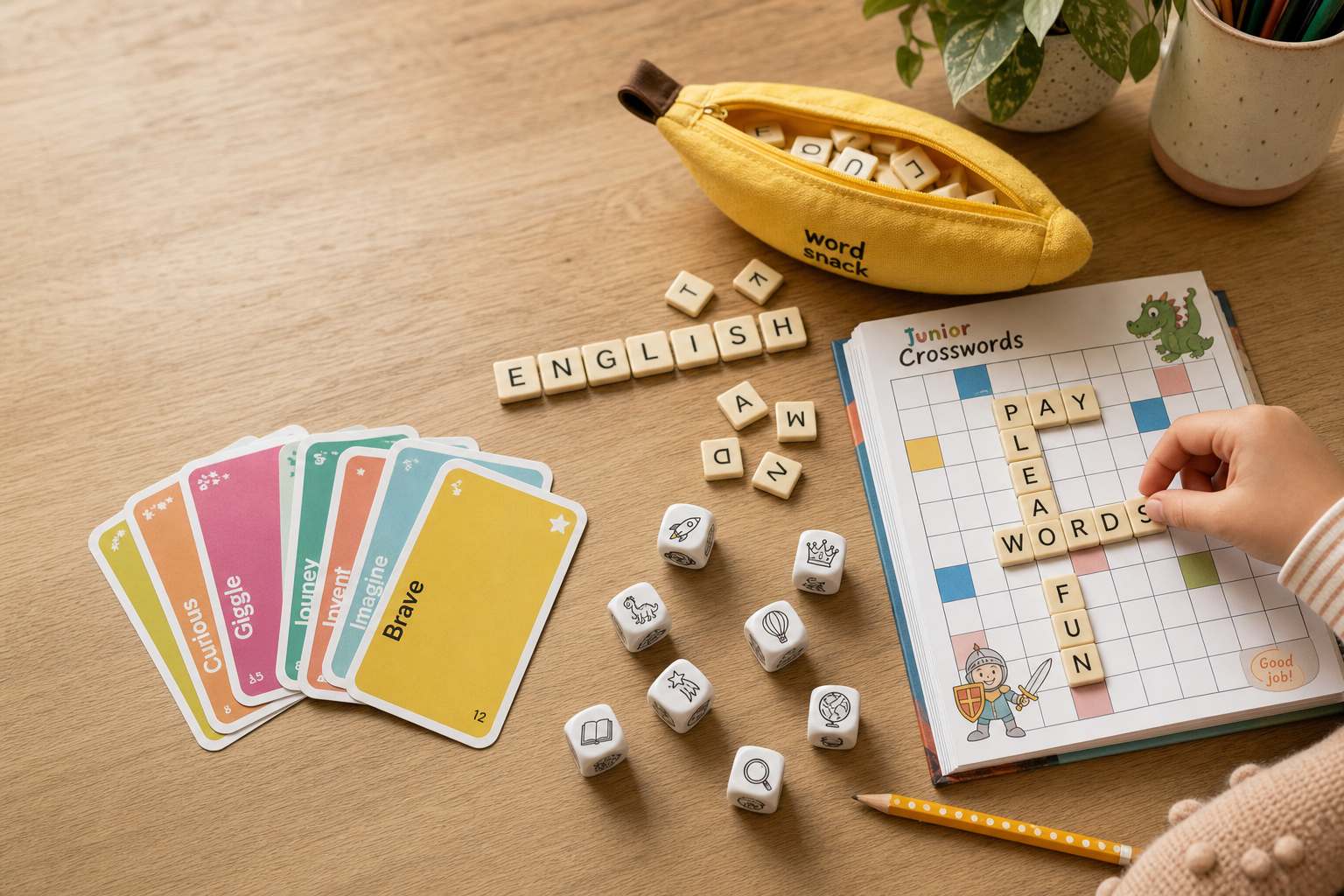
4. Bananagrams Junior
Players: 1–8 · Time: 15 min · Age: 6+ · Skill: Spelling, vocabulary, word construction
The kid-sized version of the famous banana pouch. Players race to arrange letter tiles into a connected crossword-style grid — no board, no waiting, no turns. Junior adds starter words and themed challenge cards for kids still building fluency. We’ve watched genuinely reluctant spellers go from “I can’t spell anything” to confidently building twelve-word grids inside a single school term.
Why it works: No turn-taking means zero downtime — kids stay in the word-building flow the whole game.
ESL / India note: The full Bananagrams is far easier to find in India than the Junior edition and works fine from age 7 if you play in teams. My First Bananagrams (lowercase, colour-coded tiles) is the gentlest version for the youngest learners.
5. Scrabble Junior
Players: 2–4 · Time: 30 min · Age: 6+ · Skill: Letter matching → beginner spelling, word recognition
The two-sided board is quiet genius. Side one is a matching game — find the letters that complete words already printed on the board — so a brand-new reader can play and win. Side two is real Scrabble. Most kids spend a full year on side one before flipping it, and by then they’re spelling unprompted. Long runway, real payoff.
Why it works: Built-in difficulty progression on one board — it grows with the child instead of getting shelved.
Buy: Amazon.in · Amazon US (Mattel)
6. Boggle Junior / Boggle
Players: 1+ · Time: 10–15 min · Age: 6+ (Junior 3+) · Skill: Spelling, letter patterns, word spotting
Shake the cube, then race to find words in the jumble of letters. Boggle Jr. uses picture-and-word cards for pre-readers; classic Boggle is a quick, fiercely competitive word search with no grid and no key. The longer the word, the more points — which quietly pushes kids to reach past the easy three-letter words. Keep a dictionary handy; arguments about whether “zax” is a word are part of the charm.
Why it works: Trains kids to see letter patterns rather than memorising spellings in isolation.
7. Quiddler / Quiddler Junior
Players: 1–8 · Time: 20–30 min · Age: 6+ (Junior), 8+ (classic) · Skill: Spelling, vocabulary, short-word construction
A card game where you arrange your hand into one or more words, with bonuses for the longest word and the most words. Compact, surprisingly deep, and the rare word game adults genuinely want to keep playing — which matters, because the best language practice happens when the grown-up isn’t faking enthusiasm. Quiddler Junior drops the difficulty for early readers.
Why it works: Rewards both spelling and strategic vocabulary — kids start hunting for better words, not just any word.
Best Vocabulary & Word-Meaning Games (Ages 7–12)
Spelling is mechanics; vocabulary is power. These games stretch the range of words a kid knows and can use — and the speaking-under-pressure formats are especially good for second-language confidence.
8. Taco Cat Goat Cheese Pizza
Players: 2–8 · Time: 10–15 min · Age: 8+ (works at 6 with help) · Skill: Listening, word recall, speed processing, speaking
The hand-slapping card game that took 2026 by storm — loud, chaotic, and built almost entirely out of saying English words at speed. Players flip cards while chanting “taco, cat, goat, cheese, pizza” in sequence; when the word matches the card, everyone slaps the pile. It is not marketed as educational, and that is exactly the point: for an anxious or reluctant English learner, a game this silly removes every shred of performance pressure while drilling listening and rapid word recall.
Why it works: Sneaky listening-and-vocabulary practice disguised as the most fun your kid will have all week.
Buy: Amazon.in · Amazon US · BGG
Tip: Do not play on a glass table. Every parent online learns this once.
9. Hedbanz / Guess in 10
Players: 2–6 · Time: 20 min · Age: 6+ · Skill: Question-forming, categories, descriptive vocabulary
You wear a card you can’t see and ask yes/no questions to guess what you are: “Am I an animal? Do I live in water?” It forces kids to form full English questions and use category and attribute vocabulary — exactly the structures ESL learners need to drill. Skillmatics’ India-made Guess in 10 range does the same thing with themed decks (animals, world, etc.) at India-friendly prices.
Why it works: The only way to win is to ask good questions in correct English. The game does the grammar policing for you.
Buy: Amazon.in · Amazon US (Hedbanz)
10. Apples to Apples Junior
Players: 4–10 · Time: 30 min · Age: 9+ · Skill: Vocabulary, adjectives, word association, reasoning
Players match noun cards to an adjective card, then argue why their choice is the funniest or best fit. It’s a vocabulary expander wearing a party hat — kids absorb dozens of adjectives and nouns and, more importantly, learn the connotations of words by debating them. Brilliant for upper-primary ESL learners who know words but not their flavour.
Why it works: Teaches nuance — why “ferocious” and “annoying” aren’t interchangeable — through laughter, not definitions.
11. Blurt!
Players: 3–12 · Time: 30 min · Age: 7+ · Skill: Definitions, word retrieval, listening comprehension
A definition is read aloud; players race to blurt out the word it describes. It builds the often-neglected skill of word retrieval — pulling the right word out of memory fast — and sharpens listening comprehension. Excellent in a classroom or a noisy family room.
Why it works: Connects definitions to words in the direction kids actually need: hear meaning → produce word.
Best Speaking & Storytelling Games (Ages 5–12)
Reading and spelling get all the attention, but speaking is where most English learners — especially second-language kids — actually freeze. These games loosen tongues without anyone noticing.
12. Rory’s Story Cubes
Players: 1+ · Time: 5–15 min · Age: 6+ · Skill: Narrative construction, vocabulary, speaking, sequencing
Nine dice, fifty-four pictures, infinite stories. Roll them all, then tell a story that uses every image. This is the single best speaking-and-storytelling tool we’ve seen for this age — there are no wrong answers, so even shy or beginner learners talk freely, and it builds the beginning-middle-end logic that underpins both speaking and writing. It travels everywhere, costs little, and the Voyages and Actions expansions extend it for years.
Why it works: Zero failure states. A child who’s scared to “speak English correctly” will happily narrate a dragon eating a spaceship.
13. Mad Libs (the card game & classic pads)
Players: 2+ · Time: 15 min · Age: 8+ · Skill: Parts of speech, grammar, vocabulary
Fill in the blanks — a noun here, a silly adjective there — then read the gloriously absurd result aloud. Mad Libs is the most painless grammar lesson ever invented: kids learn the difference between a noun, a verb, and an adverb because the joke only lands if they get it right. The card-game version adds a competitive, faster loop.
Why it works: Grammar terms become tools for being funny, not abstract rules to memorise.
14. P is for Pizza (Peaceable Kingdom)
Players: 2–6 · Time: 15 min · Age: 5+ · Skill: Vocabulary, categories, talking, quick thinking
Shout out words that link the letter on one card to the category on another — “Something at the beach starting with S? Sandcastle!” It’s pure talking, thinking, and laughing, and it builds the on-the-spot word-generation skill that makes kids sound fluent. Great as a warm-up before quieter games.
Why it works: Forces fast, low-stakes English production — the rep that builds real conversational confidence.
Best Grammar & Sentence-Structure Games (Ages 6–11)
The hardest, least “gamified” corner of English — which is exactly why a good game here is worth its weight in tutoring fees.
15. Word on the Street Junior
Players: 2–8 · Time: 20 min · Age: 8+ (Junior 7+) · Skill: Vocabulary, categories, spelling, teamwork
Teams pull a category, then race to think of a word and “tug” its consonant letter-tiles across the street to their side. It’s a vocabulary-and-spelling tug-of-war that gets a whole group talking and arguing over words — ideal for siblings, classrooms, or ESL groups where peer negotiation does half the teaching.
Why it works: Team play means stronger readers pull weaker ones along — the “negotiation of meaning” the 2026 ESL research flagged as gold.
16. Clover Leap / Sentence-Building Games
Players: 2–4 · Time: 15–20 min · Age: 6+ · Skill: Sentence structure, fluency, parts of speech
Form silly sentences from word cards to score and move — a hit with struggling and second-language readers because it makes sentence construction (not just single words) the playful goal. Kids internalise that English sentences have an order, and that breaking it is funny, not scary. Any “build-a-sentence” card game in this mould works; this is the category, not just one box.
Why it works: Targets syntax — the thing flashcards can’t teach — through trial, error, and giggling.
Quick Comparison: Best English-Learning Games for Kids (2026)
| Game | Skill Area | Time | Age | Best For |
|---|---|---|---|---|
| Zingo! Word Builder | Phonics / spelling | 15 min | 5+ | First reading game |
| Sight Word Swat | Sight words | 10–15 min | 5+ | High-frequency words |
| Spot It! / Dobble | Vocabulary / speaking | 5–15 min | 4–6+ | ESL beginners, travel |
| Bananagrams Junior | Spelling | 15 min | 6+ | No-downtime spelling |
| Scrabble Junior | Matching → spelling | 30 min | 6+ | Long runway |
| Boggle Junior | Spelling / patterns | 10–15 min | 3–6+ | Word-spotting |
| Quiddler | Spelling / vocabulary | 20–30 min | 6–8+ | Parents enjoy it too |
| Taco Cat Goat Cheese Pizza | Listening / recall | 10–15 min | 6–8+ | Reluctant learners |
| Hedbanz / Guess in 10 | Question-forming | 20 min | 6+ | Grammar + categories |
| Apples to Apples Jr. | Vocabulary / nuance | 30 min | 9+ | Adjective range |
| Blurt! | Definitions / retrieval | 30 min | 7+ | Word recall |
| Rory’s Story Cubes | Speaking / narrative | 5–15 min | 6+ | Shy / ESL speakers |
| Mad Libs | Grammar / parts of speech | 15 min | 8+ | Painless grammar |
| P is for Pizza | Speaking / vocabulary | 15 min | 5+ | Warm-ups |
| Word on the Street Jr. | Vocabulary / teamwork | 20 min | 7–8+ | Groups & classrooms |
| Clover Leap / sentence games | Sentence structure | 15–20 min | 6+ | Syntax & fluency |
How to Pick the Right English Game for Your Kid
You don’t need all sixteen. Use this shortcut:
- Brand-new reader (3–5): Start with Zingo! Word Builder and Spot It!. Letters and naming, zero pressure.
- Just learning to read (5–7): Add Sight Word Swat and Scrabble Junior. Fluency and sight words.
- Confident reader, weak speaker (any age): Rory’s Story Cubes + Hedbanz. Talking is the gap; these fill it.
- Second-language / ESL learner: Lead with language-neutral Spot It!, the no-pressure Taco Cat Goat Cheese Pizza, and the story-anything Story Cubes. Confidence first, accuracy second.
- Strong reader who’s bored (8–12): Quiddler, Apples to Apples Junior, Blurt!. Stretch the vocabulary ceiling.
A genuine hard-won rule from families and ESL teachers alike: buy fewer games and play them deeply. The 2026 research is blunt about this — five games played superficially don’t beat one well-chosen game that produces fifteen real minutes of English. Pick two or three, learn them properly, and rotate.
How to Use These Games Without Making English Feel Like School
The moment a kid figures out a game is “educational,” it stops working. The trick is to never say so.
- Don’t quiz during play. No “now spell it properly.” Let the game ask the question.
- Let them lose without coaching. Wrong answers are the data their brain needs.
- Play poorly sometimes. Kids who win about a third of the time stay hooked; kids who never win quit.
- For ESL kids, allow code-switching at first. Let them think in their home language and produce in English. Accuracy follows confidence, not the other way round.
- Mix learning games with pure-fun ones. A roughly 1:1 ratio keeps the shelf feeling neutral, not like a tutoring centre.
- Don’t homework-ify it. No reward charts, no “play Story Cubes before screen time.” That kills the magic instantly.
Buying English-Learning Games in India: A 2026 Reality Check
The English-games category has specific availability quirks for Indian parents.
- Reliably stocked on Amazon.in: Scrabble Junior (Mattel India), Spot It!/Dobble, Story Cubes, Taco Cat Goat Cheese Pizza, Boggle, Mad Libs, Skillmatics Guess in 10.
- Sometimes available — also check IGGames, Dice and Decks, or Meeplay: Zingo, Bananagrams Junior, Quiddler, Apples to Apples Junior, Blurt!, Word on the Street Junior.
- Harder to find (import or grey-market): Sight Word Swat, P is for Pizza, some Peaceable Kingdom titles. The original Bananagrams is far easier to get than the Junior edition.
- Excellent India-made / India-priced alternatives: Skillmatics’ Guess in 10 and Brain Booster ranges are genuinely good English-and-thinking games at ₹400–800. Funskool’s word and memory titles are budget-friendly classroom staples.
A complete beginner English shelf — Zingo Word Builder, Spot It!, Story Cubes, and Scrabble Junior — covers phonics, vocabulary, speaking, and spelling for roughly ₹4,000–5,000 / $60–70 total. That’s a genuinely complete starter kit, and kids will play all four for fun on a rainy Sunday.
For a broader India shelf, see our best family board games in India 2026 guide.
Frequently Asked Questions
What are the best educational games for kids learning English in 2026?
For most families the strongest starting trio is Zingo! Word Builder (phonics and spelling), Spot It! / Dobble (vocabulary and speaking), and Rory’s Story Cubes (storytelling and confidence). Together they cover reading, speaking, and word-building, and all three suit second-language learners. Add Scrabble Junior once your child is reading short words.
Which board game is best for ESL / kids learning English as a second language?
Start with Spot It! / Dobble — its rules need almost no English but every turn forces English naming, so it’s the gentlest on-ramp for a nervous learner. Pair it with Taco Cat Goat Cheese Pizza (zero pressure, lots of listening) and Story Cubes (free, judgement-free speaking). Confidence first; accuracy follows.
Are board games actually better than apps for learning English?
For early-primary kids, generally yes. Apps optimise for engagement loops; physical games optimise for face-to-face talking, tactile memory, and uninterrupted attention — and a 2026 ESL gamification review found collaborative, talk-heavy formats especially good for language gains. The honest answer is both: apps for travel and quiet time, board games for genuine speaking practice.
What’s the best game for a kid who can read but won’t speak English?
Rory’s Story Cubes and Hedbanz / Guess in 10. Story Cubes have no wrong answers, so even shy kids talk; Hedbanz forces full English questions to win. Both target speaking, which is the skill flashcards and reading apps almost completely ignore.
At what age can my child start these English games?
Letter and naming games like Zingo! and Spot It! Junior work from age 4–5. Spelling games (Bananagrams Junior, Scrabble Junior) suit 6+. Vocabulary and grammar games (Apples to Apples Jr., Mad Libs, Quiddler) land best at 8+. Match the game to the skill, not just the age on the box — many “8+” games work earlier in teams.
How long should English-game sessions be?
15–25 minutes is the sweet spot for under-eights. Past 30 minutes, attention frays and the language value drops sharply. Two short sessions beat one long one, and 2–3 sessions a week across different skills (one spelling, one speaking) produces real, visible gains across a school year.
Final Word
English-learning games work because they sidestep the one thing that makes language hard for kids: the awareness that they’re being tested. A child playing Taco Cat Goat Cheese Pizza isn’t practising listening — they’re trying to slap the pile before their sister. The English happens anyway.
If you’re building an English shelf from zero, start with four boxes across four skills: Zingo! Word Builder, Spot It!, Rory’s Story Cubes, and Scrabble Junior. Under ₹5,000 / $70, genuinely complete, and your kid will reach for them on a wet afternoon for fun. Add Quiddler and Apples to Apples Junior when the vocabulary ceiling needs raising. The collection grows naturally from there — and so, quietly, does your child’s English.
Related reading
- Best board games for kids in 2026: the complete guide — toddlers through age 10, every category.
- Educational board games for 6 year olds in 2026: math, reading, logic & STEM — the broader skill-builder shelf.
- Best educational games for kids that are fun in 2026 — 15 picks kids beg to replay, by type of fun.
- Best memory games for kids in 2026 — Spot It!, matching and brain-training overlap.
- Best family board games in India (2026) — India stocking reality and game-night context.
Got a favourite English-learning pick we missed? Drop it in the comments or tag us on Instagram. We update this guide each school year based on what families and teachers actually keep on rotation.
Leave a Reply